Our statement on the US Supreme Court’s Decision to Roll Back Abortion Rights

The U.S. Supreme Court’s decision to strike down abortion rights is a misogynistic attack on people who can become pregnant. We condemn this assault on bodily autonomy and workers’ rights, which will fall the hardest on poor people, people of color, immigrants, and LGBTQ+ people.

Reproductive rights are workers’ rights. Across the country, too many workers already face serious barriers to staying healthy: many of us work without the right to paid time off and are paid poverty wages that prevent us from affording basic necessities like medical care, childcare, and food. Now, millions of us no longer have the fundamental right to bodily autonomy, further limiting our ability to make our own decisions about what’s right for our health and economic stability.

This ruling erects yet another barrier for poor and working people trying to survive and thrive—and it’s part of a broader right-wing, anti-democratic attempt to control and disempower working class people. Here in Washington state, we’ll keep building the power we need to ensure everyone can lead a healthy and dignified life.

Centro Chinampa is now open in Yakima!


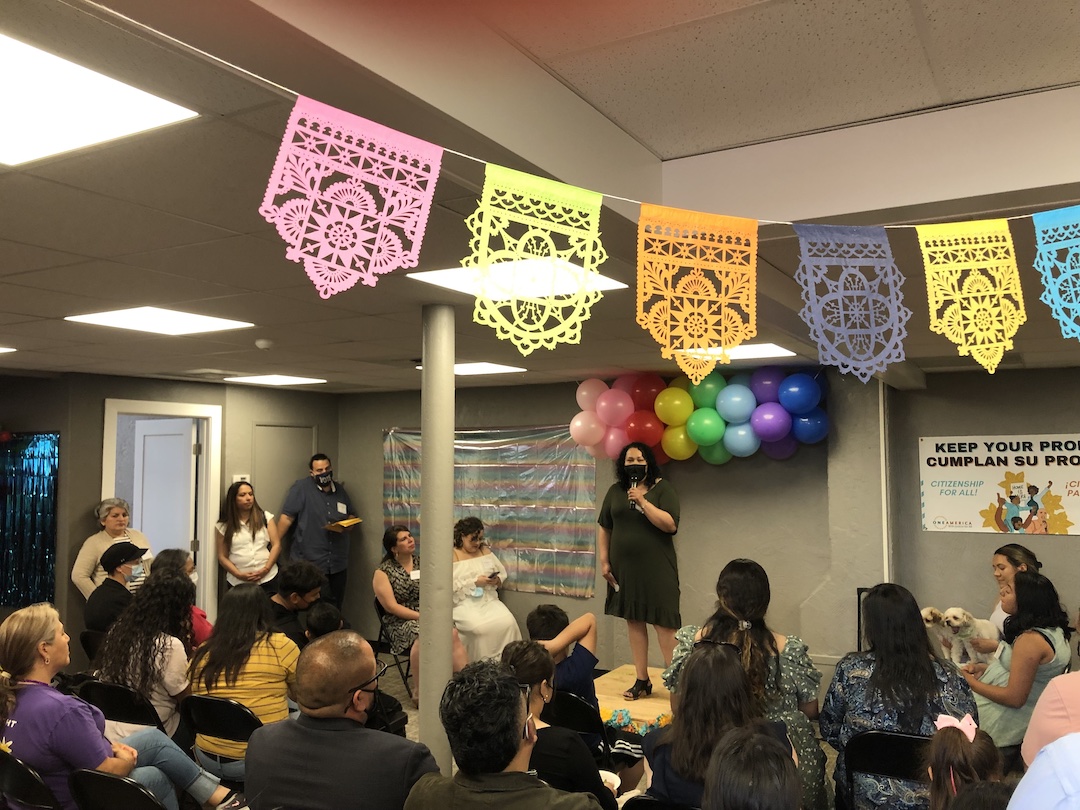
More than one hundred people came together earlier this week to celebrate the grand opening of Centro Chinampa, our new worker center in Yakima!

Packing house worker leader Angie Lara speaking at the Centro Chinampa grand opening.

Centro Chinampa is a first-of-its-kind hub for worker and immigrant rights in Central WA—a space for us to gather as immigrants, workers, and community to defend our rights, get involved in politics, and build collective power.

We’re proud to collaborate on this worker center and share a roof with OneAmerica, the Washington Immigrant Solidarity Network, and the Washington State Labor Council.

The center is named for the ancient Chinampas of Anahuac (the territory that is now Mexico), floating gardens cultivated and cared for by the local community. As OneAmerica organizer Audel explained at last night’s event: “These practices bonded people to each other and the places they inhabited. We see many parallels between these traditions and the space we have created at Centro Chinampa.”

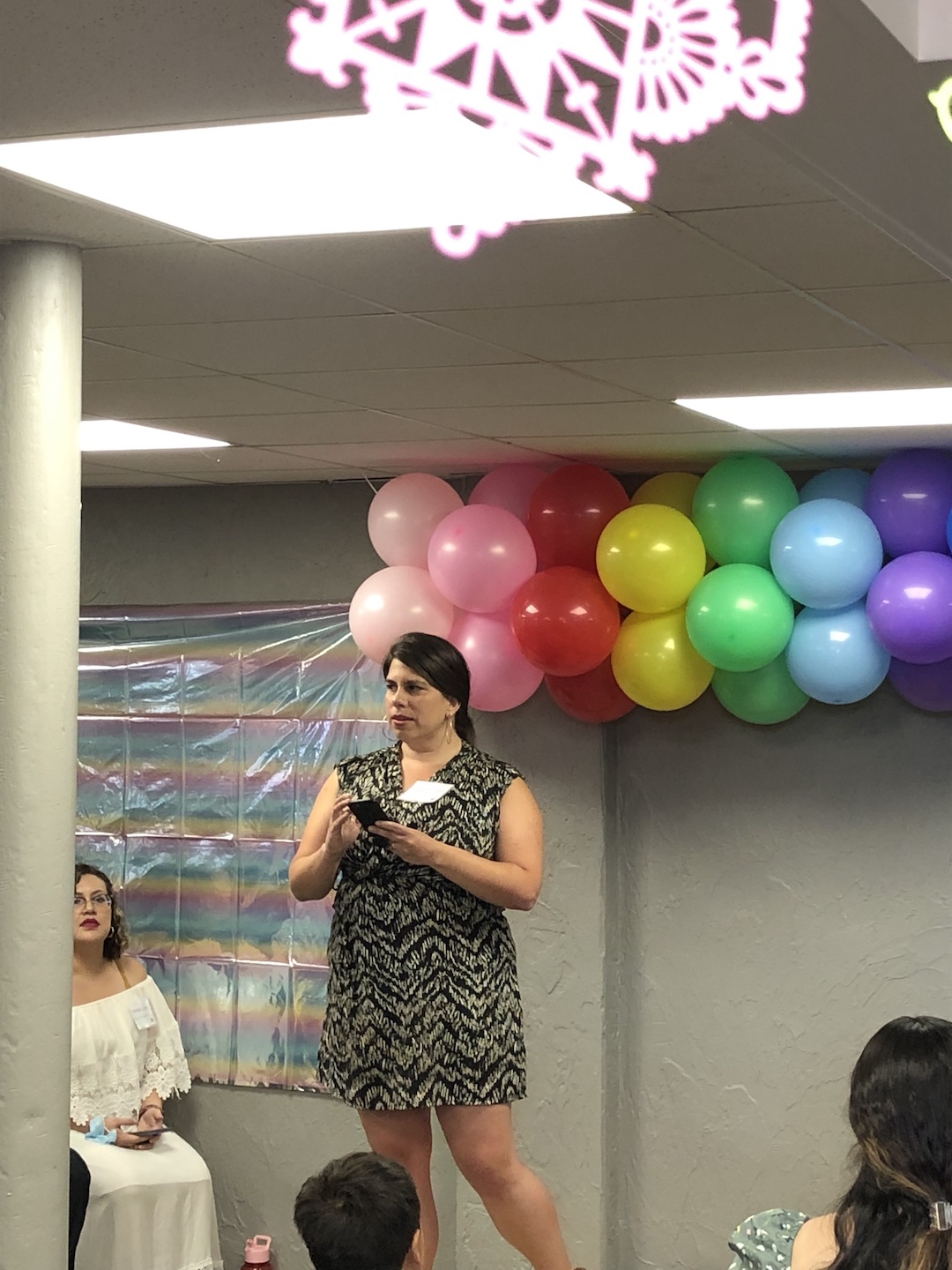
Danielle Alvarado, Executive Director of Fair Work Center, speaking at the Centro Chinampa grand opening.


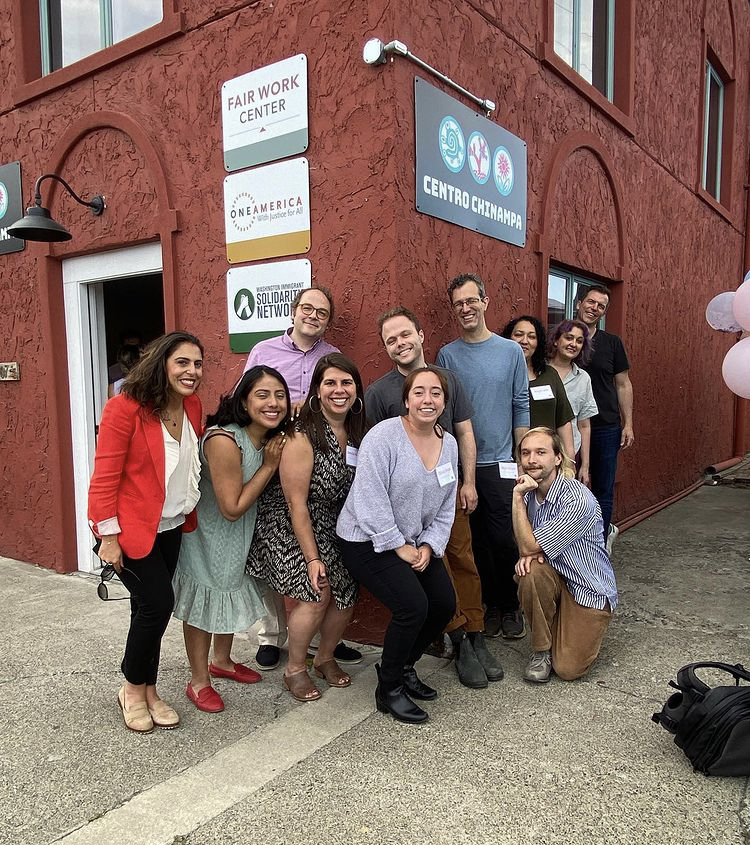
Fair Work Center staff outside Centro Chinampa.

It was a beautiful night celebrating community and an exciting vision for worker power in Central WA. You can read all about it in the Yakima Herald and El Sol De Yakima — and then, if you’re able, chip in to support our Yakima Worker Center Fund, which will ensure we have the resources we need to move this vision forward.

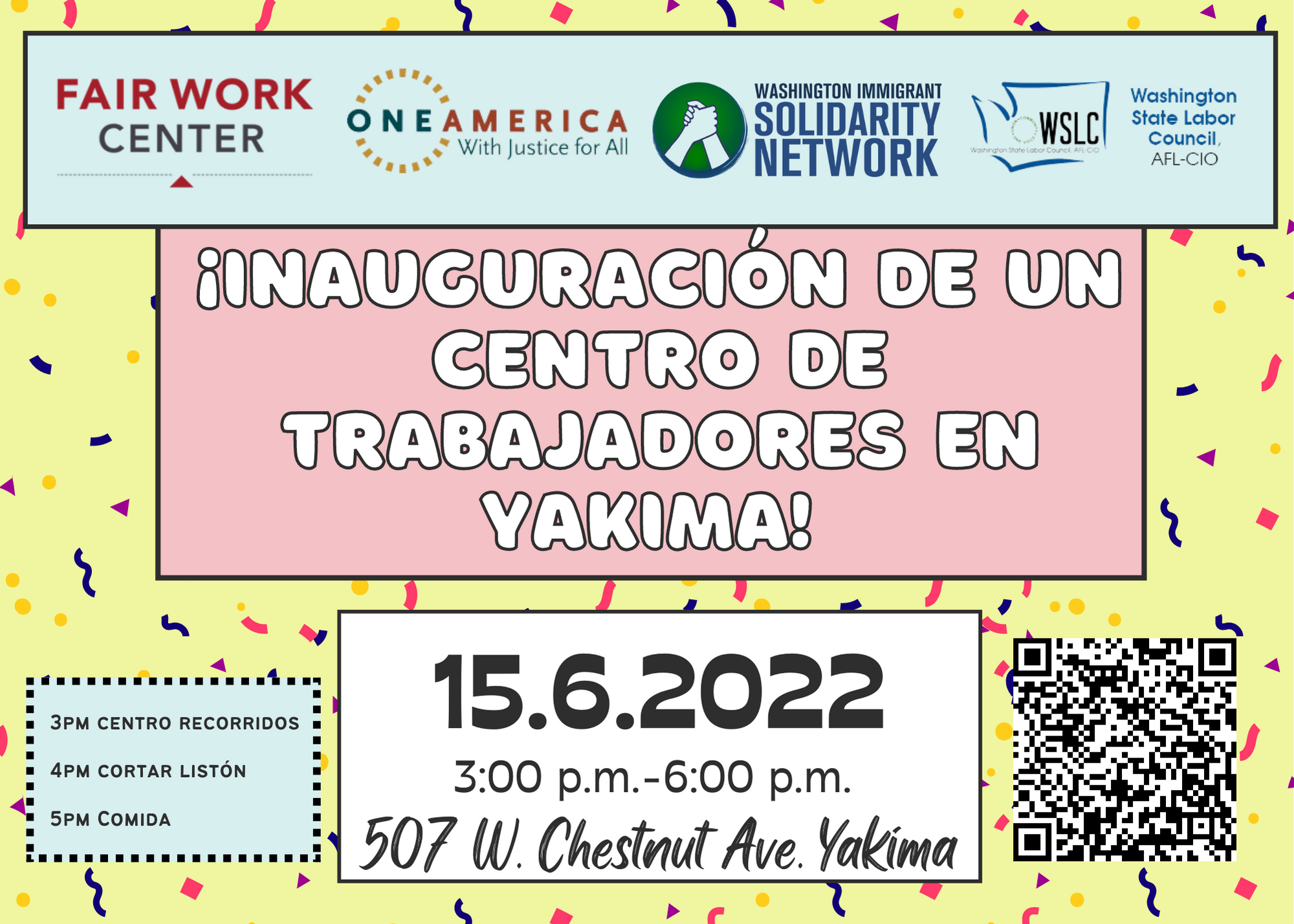
¡Gran inauguración del centro de trabajadores en Yakima — 15 de junio!

¡La gran inauguración del nuevo centro de trabajadores en Yakima viene el 15 de junio…y te invitamos a festejar con nosotros!

Nuestro nuevo centro en Yakima — un esfuerzo colaborativo entre OneAmerica, WAISN, y WLSC — será un espacio focal en donde la comunidad y los trabajadores pueden venir para aprender de sus derechos, obtener apoyo legal cuando los derechos no se están respetando, y crear un poder comunitario para luchar por nuevos derechos.

Únete a nosotros para esta celebración comunitaria. RSVP aquí.

Si no puedes venir en persona, ¿nos puedes apoyar con una donación? Cada dólar nos ayuda en dar talleres sobre los derechos laborales y proveer apoyo legal a los trabajadores en el Valle de Yakima: CONTRIBUIR HOY

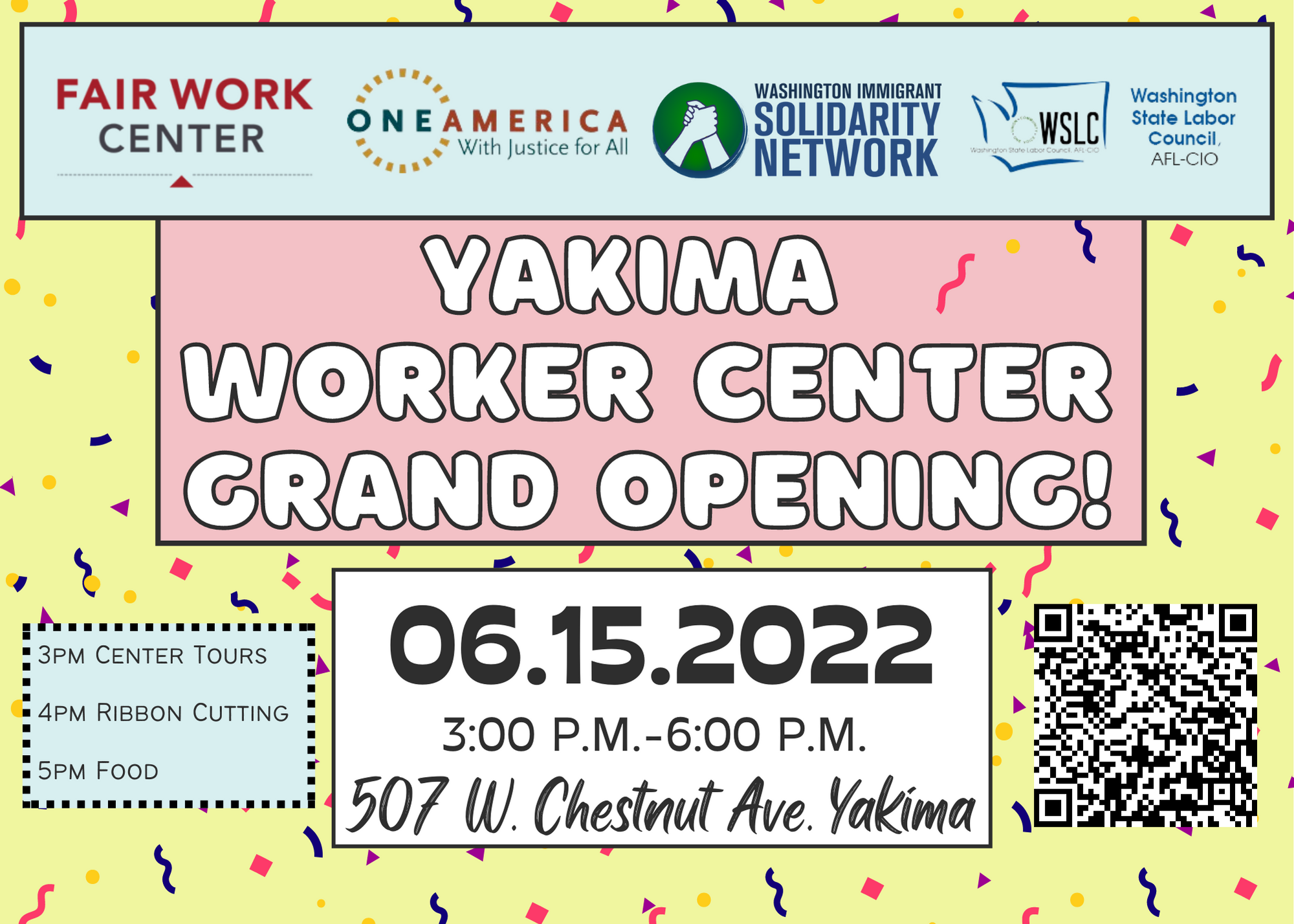
Yakima worker center grand opening — June 15th

The grand opening of our new worker center in Yakima is coming up on June 15th…and you’re invited to join in the festivities!

Our new location in Yakima—a collaboration with OneAmerica, the Washington Immigrant Solidarity Network, & the Washington State Labor Council — will be a regional hub for workers across the Yakima Valley to learn about their rights, get legal help when those rights are being violated, and build the power they need to address the challenges they face. 

Can you join us for this community celebration? Click here to RSVP.

If you can’t make it out in-person, can you support our expanded presence in Yakima with a donation? Every dollar helps run Know Your Rights workshops & provide legal help to workers across Central WA: Make a contribution today

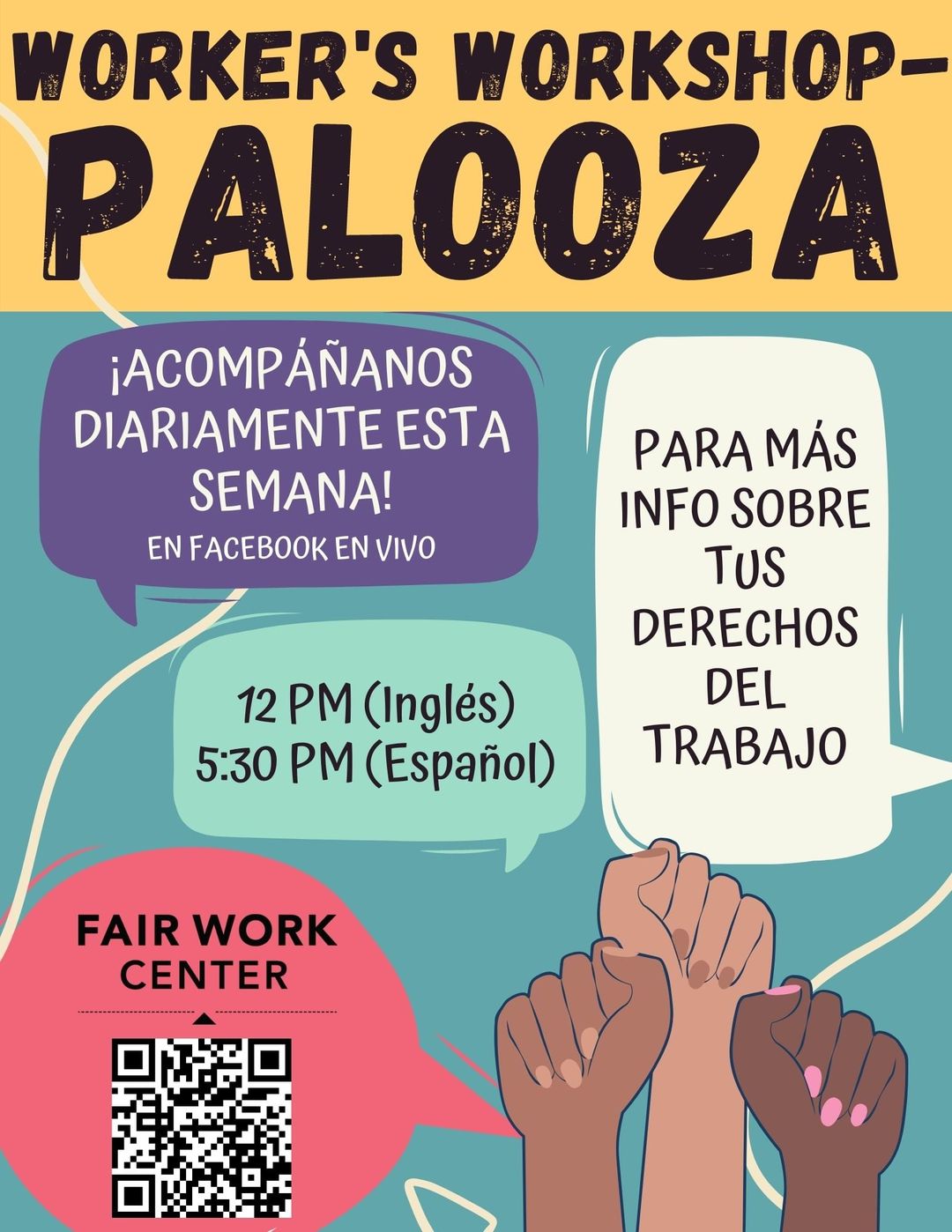
Join us online this week for Workers’ Workshop-Palooza

We’re gearing up for May Day—aka International Workers’ Day—with an entire week of online workers’ rights workshops. It’s the Workers’ Workshop-Palooza. Have a question about your rights at work? Missing a paycheck? Not getting your breaks? We’ll share details about your rights & answer your questions.

Every day this week, 15-minute workshops begin at NOON in English and 5:30 PM in Spanish. Click here to get the link.

  • Monday: Minimum Wage & Overtime
  • Tuesday: Breaks & Tips
  • Wednesday: Paid Sick and Safe Time
  • Thursday: Hotel Worker Protections
  • Friday: Wage Theft

May Day is a time to celebrate the victories workers have achieved by standing together—but our rights are only real if we know what they are and how to enforce them. Tune in to our workshops here.

Efraín’s story: “It felt like a total lack of respect”


Efraín worked as a cook for a sports bar and grill in Seattle. He was regularly required to work overtime hours, didn’t get any breaks, and was only paid for a flat 40 hours each week—no matter how many additional hours he actually worked. And when he tried to take a paid sick day, his employer fired him.

He got in touch with our legal clinic and we took the case. Now, Efraín is getting $72,000 in a settlement — more than a year’s worth of pay.

Here’s Efraín’s story, translated from Spanish:

(Haga clic aquí para leer la versión original en español)

“After they hired me, I worked hard for six months while earning the minimum wage they offered me. Six months in, my manager called me in to talk. I brought my coworker to help translate to English, because our manager only spoke English, and didn’t speak a word of Spanish. My boss told me that I was doing really well and offered me more responsibility in the kitchen. And with that, he offered me a salary of $1000 a week to work Monday through Sunday—I’d have to be there seven days a week.

From then on, I had to work at least 55 hours a week, sometimes up to 60 hours—all for $1,000 a week. They weren’t paying me anything more for all those extra hours. So they already owed me a ton of money. Still, I needed the job.

It was so stressful working six or seven days a week. I’d leave work to head home at 1:30am. Later, it became 2:30am. I couldn’t take breaks at work or days off. I was only sleeping about 4 or 5 hours a night.

I felt terrible. Before, this job was already so demanding—and now it was even more work. Our boss didn’t care about the effort we were putting in or about how little he was paying us. He didn’t care at all. Every year, the owner hosted a party to celebrate the staff, but they never invited those of us who worked in the back, in the kitchen. All of that stuff, the pay and the exclusion and everything, it felt like a total lack of respect.

One day, very early in my shift, I told my boss that I’d slept really poorly and needed to go to the dentist to deal with some bad tooth pain I was having. I’d never missed work, but today I just couldn’t do it. He told me it was okay to leave and go to the dentist—so I did. But maybe two hours later, he called to tell me I was fired.

I was so angry and frustrated. I thought about all the work I did there, about how none of it mattered to them, they didn’t value any of it. It’s still very, very frustrating to think about.

I’d heard about Fair Work Center about five years ago, during an English class I was taking at the time. I remember our teacher telling us that it was a place to go if our rights were being disrespected. So I got in touch with the lawyers at Fair Work Center, and after talking they decided to help me fight my case.

I just want other workers to know about what rights we have. Sometimes, as undocumented people, we don’t know where to turn or who to take our questions to when our rights are being violated. In the past, I haven’t said anything, I’ve stayed quiet because I’ve been afraid of bad consequences and all that—I’ve never said ‘let’s fight back, let’s take them to court, let’s do it.’

But with this situation, I knew I’d been wronged—and I knew I needed to enforce my rights. And that’s what we did.”

Are your rights at work being violated? Need help?

Call us at 844-485-1195, email help@fairworkcenter.org, or fill out this form.
Los trabajadores de agricultura en WA ahora deben recibir un pago extra cuando trabajan horas extras

Haga clic aquí para leer esta noticia en inglés.

Miles de trabajadores de agricultura en WA ahora deben recibir un pago extra cuando trabajan horas extras. Durante la sesión legislativa en 2021, los trabajadores agrícolas ganaron una nueva ley que puso fin a la exclusión racista de trabajadores agrícolas desde esta protección laboral básica.

En 2022, todos los trabajadores de agricultura tienen derecho a recibir un pago de *tiempo y medio* para todas las horas trabajadas después de 55 en una semana. En el transcurso de los siguientes años, el número de horas requeridas para recibir un pago extra va bajando poco a poco hasta llegar a 40 horas en una semana.

  • 2022: pago extra después de 55 horas/semana

  • 2023: pago extra después de 48 horas/semana

  • 2024: pago extra después de 40 horas/semana

OJO: debido a un dictamen de la Corte Suprema del Estado de WA en 2020, los trabajadores de lechería ya tienen derecho a un pago extra después de trabajar 40 horas en una semana. 

¿Te está pagando lo justo tu patrón? ¿Recibes un pago extra?

Agricultural workers in WA will now get overtime pay when they work overtime hours

Haga clic aquí para leer esta noticia en español.

Tens of thousands of agricultural workers across the state now get overtime pay when they work overtime hours. That’s because of a groundbreaking state law won by farmworkers during the 2021 legislative session, which reversed the longstanding racist exclusion of farmworkers from this basic labor protection.

In 2022, all WA agricultural workers have the right to receive 1.5x pay for each hour worked after 55 hours in a week. Over the next three years, the number of hours before overtime kicks in will decrease until eventually reaching 40 hours/week.

  • 2022: overtime pay after 55 hours/week.
  • 2023: overtime pay after 48 hours/week.
  • 2024: overtime pay after 40 hours/week.

Note: due to a WA Supreme Court decision in 2020, dairy workers get overtime pay when they work more than 40 hours in a week.

Is your boss paying you overtime? What are you seeing?

Seattle gig worker hazard pay and sick days are still in effect

You may have heard that a bill to repeal hazard pay for grocery workers was passed in Seattle. Grocery worker hazard pay will end 30 days after the Mayor signs the bill.

But gig workers in Seattle should know this: laws that ensure you receive $2.50/job hazard pay and have access to paid sick days are still in effect through the pandemic emergency. 

If you’re a gig worker in Seattle, you still have these rights:

  • Hazard pay: If you do gig food delivery work, you are entitled to $2.50 in hazard pay for each restaurant or grocery delivery you make inside the Seattle city limits. Hazard pay must be listed separately on your pay report, and paid out on top of what you would otherwise be paid.

  • Sick leave: If you do gig delivery work or drive for Uber/Lyft, you have the right to take paid sick days. You accrue paid sick days going forward at a rate of 1 day for every 30 days you work. When you take a paid sick day, you’ll get paid based on your average daily compensation, including tips.

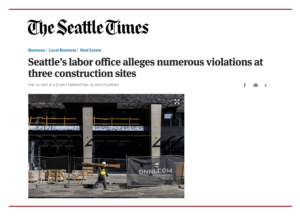
Dozens of Seattle construction workers are seeing workplace-wide accountability for workplace-wide violations of their rights


We know that when there’s one labor rights violation in a workplace, there’s often more.

And that’s exactly what the Seattle Office of Labor Standards found in a recent investigation into two Seattle-area construction companies. After several immigrant construction workers brought concerns about their rights to CASA Latina — a trusted organization in the Latinx community, and one of our close partners — they got connected with City investigators, who in turn started looking into overall labor rights practices at the companies.

OLS found a long-standing pattern of labor rights violations at the two companies, including a widespread practice of ignoring minimum wage and overtime protections. And those violations aren’t limited to the handful of workers who spoke up: all told, OLS is forcing the companies to pay $2,055,204 to 53 workers.

Such robust and wide-ranging enforcement proves the power of our system of community-based labor standards enforcement in Seattle. The immigrant workers in this case already had strong existing relationships and trust with CASA Latina. When they came forward with concerns about their rights, CASA Latina remained involved throughout the entire investigation, helping bridge communication and build trust between workers and the City’s investigators. 

That trust is essential when it comes to ensuring workers can enforce their rights at work — and that’s especially true for immigrant workers of color, who face particularly high rates of labor rights violations, and who often don’t know or believe that government agencies like OLS are there to help.

This collaborative process means big things for workers: backed up by local organizations bringing community-based expertise, and supported by the resources and investigative power of city government, workers are increasingly seeing workplace-wide accountability for workplace-wide problems.

These partnerships between workers, community organizations, and city government are no accident. For years, community organizations like Fair Work Center and CASA Latina have been working with the City of Seattle to fund and build out this cutting-edge approach to labor standards enforcement.

It’s working. Seattle is leading the way by passing first-in-the-nation labor standards. And we’re backing those laws up with an equally innovative approach to enforcement that’s successfully moving money from companies to workers and holding employers accountable.

As the Seattle City Council turns its attention to the annual budget, it is critically important that city leaders continue to support and fund this community-based labor standards enforcement system. Our labor laws are only as strong as our ability to enforce them — and city leaders need only look to recent enforcement victories for workers as proof of just how powerful that enforcement can be.