RESTAURANT WORKERS WIN A NEW TOOL TO GET WHAT WE’RE OWED


“My first time working in a restaurant you never got a break…One day, we had a new hire and she took a 30 like she was supposed to, and when she got back, she got yelled at by the managers because while, yes, we legally should get breaks, that ‘isn’t what we do here.’”

-Restaurant worker, in testimony at King County Board of Health

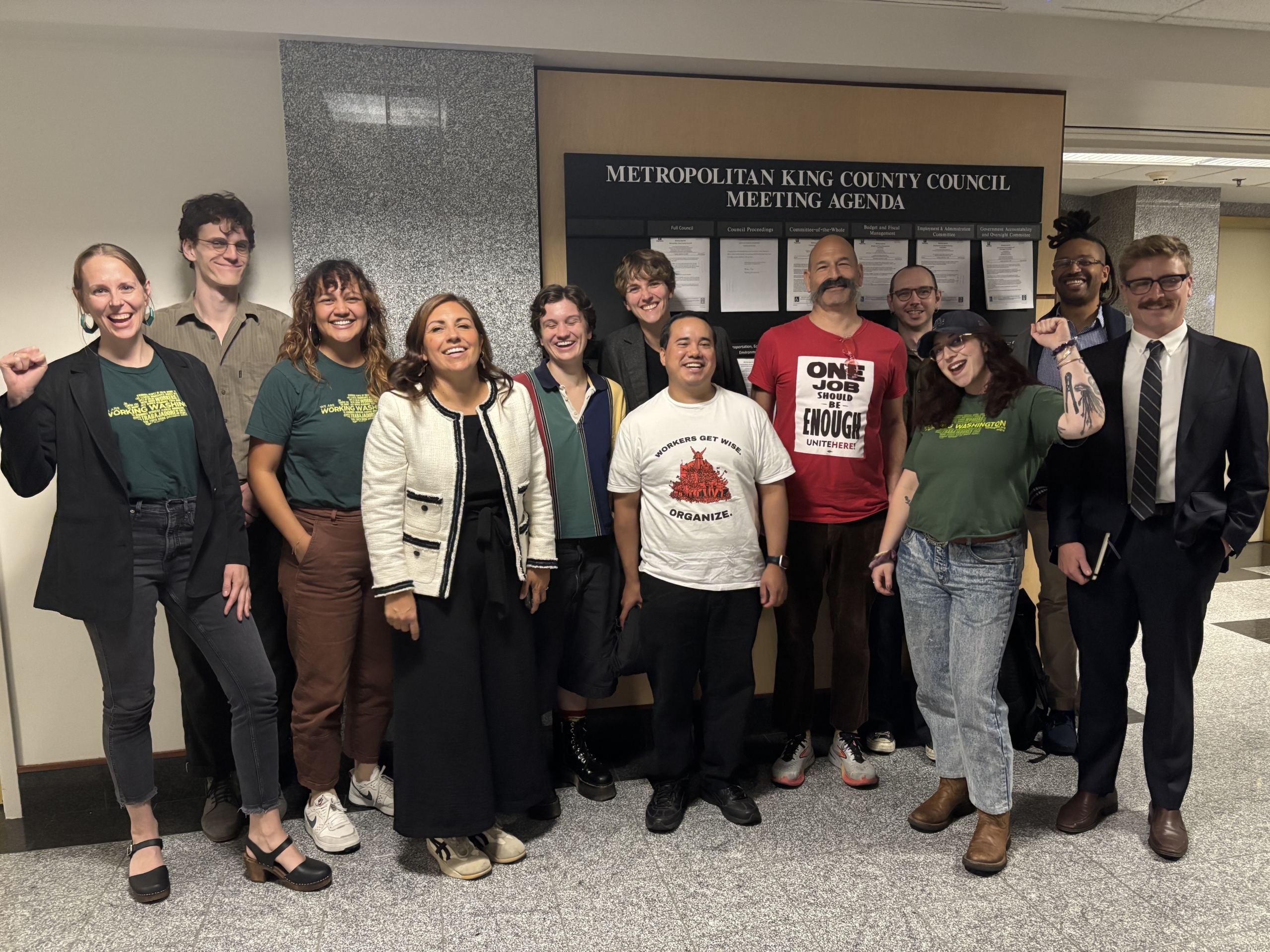
The vote is in and restaurant workers got a win! Starting next year the Board of Health can treat violations of workers’ rights as the public health issue they are. For too long, workers in food service have had to choose between a paycheck and our health. This puts workers and the customers we serve at risk. The King County Board of Health voted in our favor and now, through the county health department, we’ll have another tool to get what we’re owed. 

Too many of us can’t rely on our bosses respecting our rights at work and it is putting us and the public in danger. Some bosses intentionally make us work through breaks to the point of exhaustion. Others make us jump through hoops for those breaks or to take the paid sick leave we’ve earned. It is not just morally wrong and illegal. It is a dangerous public health problem. One Capitol Hill worker said it best in their testimony at the King County Board of Health:

“None of us really wants to work side by side with someone who is contagious with COVID or the flu. None of us wants to be served by someone who’s contagious or exhausted to the point of being unsafe. These workplace issues are intrinsically public health issues.”

With their expanded power, the county health department will be able to ensure not only that customers have safe places to eat and employers have safe businesses to run, but that restaurant workers have good, safe workplaces! If a restaurant has certain unpaid workers’ rights violations, health inspectors can go to the restaurant to conduct another health inspection. The health department can also place a second placard at the door, in addition to the health rating placard. The second placard will advise the public that the restaurant is under increased inspection because of unresolved workers’ rights violations. These are important tools that keep customers informed, more safe, and could be strong deterrents that prevent restaurants from violating our rights in the first place. They’re also just plain common sense. As King County Councilmember Teresa Mosqueda said, using a phrase a worker gave in testimony:

“Where there is smoke, there is often fire – if workers’ rights are being violated, we should at the very least make sure the food that is being served meets our public health food-safety standards and work to prevent the public’s health from being at risk.”

The newly expanded health code enforcement will also level the playing field for the small businesses that treat workers fairly and operate by the rules. Businesses that cheat their workers are undercutting fair businesses all to shave a few dollars off payroll. That’s just not right. These new health code enforcement powers will help remove the “race to the bottom” that unfair businesses are forcing onto the whole industry.

Food safety isn’t just about gloves and hairnets. It is also about workers being healthy and alert enough to work safely. Diners should be able to trust that the sandwich in front of them wasn’t made by someone pressured to work through a fever. Exhausted workers are more likely to make mistakes. This can lead to everything from knife wounds, food contamination, or even forgetting details on orders like allergies. The ability for the health department to make additional health inspections and advise the public that those increased inspections are due to unpaid labor violations increases public awareness and trust.

In conclusion: organized workers stay winning! And when workers win, everyone else does too.
For Immediate Release:
Sep. 12, 2025

Contact: Hannah Sabio-Howell | hannah@workingwa.org, (206) 573-2317

Adult Family Home workers seek to end unjust labor protection exclusions

Fair Work Center, on behalf of workers, to argue before Washington Supreme Court that exclusions from minimum wage rights for live-in care workers are unconstitutional

A Washington Supreme Court ruling in favor of workers could lead to a broader legislative action nullifying the live-in exemption and expanding coverage of fundamental labor standards to thousands of low-wage Washington workers

Olympia, WA – The Washington Supreme Court on Tuesday will hear oral arguments, presented by Fair Work Center Legal Director Jeremiah Miller, on the case of Bolina et al v. Assurecare, LLC asserting that the 64 year old exemption of live-in care workers from bedrock labor protections is unconstitutional.

The Case

Fair Work Center will be representing six workers formerly employed by several Adult Family Homes (AFHs) run by Assurecare. The workers – Ms. Bolina, Mr. Payag, Ms. Ocampo, Ms. Robles, Mr. Castillo and Mr. Villalobos – came to Fair Work Center in 2022 with horrific reports of workers’ rights abuses. The workers often worked shifts that were 24 hours long, without uninterrupted breaks or sleep, resulting in injuries and infections like COVID-19. The impact of these injuries and illnesses on these caregivers was compounded by their lack of access to sick leave. For this back-breaking labor, they were paid a flat daily rate regardless of how many hours they worked, amounting to as little as four dollars per hour with no overtime pay.

This experience for live-in care workers at AFHs is common. Though Washington is, in many ways, a national leader in protecting workers’ rights, the backbone of our state’s labor laws (the

Minimum Wage Requirement and Labor Standards Act, also known as the MWA) is fundamentally shaped by flawed federal laws. It contains unexplained exemptions to various labor protections for many categories of workers, including workers who live where they work.

The History

Accordingly, the MWA exempts “[a]ny individual whose duties require that [they] reside or sleep at the place of [their] employment…” from its protections. This exclusion derives from a shameful tradition in the United States denigrating the value of domestic work (including caregiving work), and the explicit exclusion of work that is performed by non-white, non-male identifying people from foundational labor laws.

The federal government in the 1930s enacted groundbreaking worker protections in the form of various “New Deal” laws, including the National Labor Relations Act, the Social Security Act, and the Fair Labor Standards Act. But these laws explicitly or implicitly excluded domestic workers and agricultural workers, part of a pattern of systematic and intentional exclusion of Black and female workers from all major New Deal legislation. As a tool for advancing overtly discriminatory interests, drafters used facially neutral categorical exclusions as proxies for excluding Black and female labor forces from the New Deal. The goal was simple: maintain the existing social hierarchy and prevent Black and female workers from gaining political power. Echoes of these decisions were codified in Washington law, with little or no discussion, in the 1960s.

The Impact

For live-in care workers today, these exemptions allow AFH employers to create work conditions that would be illegal for most workers, including other caregivers doing identical work, who do not live where they provide care. Wages on the order of a few dollars per hour, no breaks, and no access to state-protected sick leave are conditions that no worker should face. The very idea that “living-in” somehow makes a worker less deserving of protection cannot be separated from the social, cultural, and political contexts that have informed the way society devalues labor performed in the “domestic” sphere. It is time we shed the deeply racist and sexist thinking that never had any place in our country’s labor laws and certainly doesn’t today.

The Possible Outcome

Fair Work Center on Tuesday will seek a judgment from the Washington State Supreme Court that declares the live-in exemption to the MWA unconstitutional. If successful, this decision would follow on the heels of a 2020 decision (Martinez-Cuevas et al. v. DeRuyter Bros. Dairy Inc.) in which the Washington Supreme Court determined that excluding workers in dangerous jobs from the MWA violates the Washington Constitution’s unique Privileges and Immunities Clause. As a result, the Washington state Legislature ended the overtime exemption for all agricultural employees. Fair Work Center’s case could similarly extend these constitutional protections to live-in caregivers, who are overdue for access to minimum labor standards.

Comments from plaintiffs and legal experts are included below. Contact Hannah Sabio-Howell to arrange an interview.


“Justice is slow, but I’m glad we made it to this point. I hope the Court listens to the experiences of workers in this job. This job isn’t easy, and you don’t get compensated much. You’re there 24/7, taking care of up to six people at the same time that all have different needs, exposed to diseases or possible back injuries every day, with no health benefits or the right to a 401k. I hope we come away with laws that protect us and that other Adult Family Care workers learn we deserve more.” – Hollee Christian Castillo, plaintiff


“The courage of the six workers I have the honor of representing is emblematic of the tenacity and commitment of this entire industry of workers. Adult Family Home workers care for elders and disabled loved ones day in and day out, and, since the creation of Adult Family Homes in the late 1980s, have worked in one of the few industries exempted from the right to fair pay and safe workplaces. It’s time for this shameful legacy in our labor laws to end in Washington state.” – Jeremiah Miller, Legal Director


WASHINGTON STATE SENATE ADVANCES THE DOMESTIC WORKERS BILL OF RIGHTS, WORKERS REACT

For Immediate Release: March 5, 2025

Contact: Hannah Sabio-Howell | hannah@workingwa.org, (206) 573-2317

Washington state takes a major step toward becoming the thirteenth state in the nation to end the exclusions that shut domestic workers out of minimum wage, sick time, overtime, and other basic labor standards

Following news of the victory, domestic workers speak to the importance of including the industry in fair workplace standards

Seattle, WA – The Washington state Senate today approved a bill to end the historic exclusions of domestic workers from basic, common-sense labor standards such as minimum wage, sick time, and protection from discrimination.

Going back to the dawn of the New Deal, the domestic work industry – made up mostly of immigrants and women of color, then and now – has been legally excluded from the labor standards that ensure stability and prosperity for Washington families. As a result, an estimated 100,000 workers in our state labor in the shadows, often making subminimum wage, working without proper breaks, and feeling unable to speak up for themselves.

Key elements of the policy approved by the Senate today include:

  • Wage and Hour Standards: Establish the right to minimum wage, overtime pay, meal and rest breaks, and notice of termination for domestic workers.

  • Sick Time: End the exclusion of domestic workers from the current state sick time law.

  • Anti-Discrimination & Anti-Retaliation: Prohibit discrimination, harassment, and retaliation based on protected characteristics, including immigration status; remove eight-employee minimum for domestic worker employers; and provide additional protections specific to domestic workers, such as prohibiting the seizure of personal documents and monitoring of private activities.

  • Written Agreements & Record-Keeping: Require written employment agreements and record-keeping of hours, wages, and other employment terms; require “reasonable time” for a worker to review the agreement and to have it translated into the language they understand.

  • Enforcement: Grant authority to the Department of Labor & Industries to investigate complaints, issue citations, and collect unpaid wages; establish private right of action, and create community/agency partnerships to ensure robust and culturally competent enforcement.

Twelve other states, including Oregon and California, have passed a statewide Domestic Workers Bill of Rights, including several major cities across the country. It is more important than ever that all Washington workers get the pay and dignity they are owed. Washington’s economy is the strongest in the nation for a reason – we have worked hard to raise wages and workplace standards for millions, but domestic workers have been left out of that growth. It’s time we make our economy truly inclusive by raising standards for this largely immigrant workforce that sustains so many working-class families and families of color.

The bill now advances to the Washington state House for consideration. If passed, domestic workers across Washington would finally be eligible for the same basic labor standards that workers in most other industry rely upon for stability and dignity in the workplace.

Comments from workers are included below. Contact Hannah Sabio-Howell to arrange an interview.


“Our work is physical, emotional and essential, but many of us still face abuse due to lack of information and enforcement of existing laws. It is crucial that employers have guidance on our rights and that the use of contracts is mandatory to ensure fair conditions.” – Elena Echeverría, cleaner

Many endure sudden cuts to their hours without notice, withheld wages, and the inability to take sick leave out of fear of losing their jobs. Passing this law is critical to expanding the rights of domestic workers and ensuring dignity and fairness for everyone in this profession.” – Lisbeth Herrera, nanny

“During the week I take care of a baby that I adore. Her moms, a pediatrician and a surgeon, are able to focus on their patients because of my work. Yet as essential as my work is, I do not have access to basic rights such as health insurance. We face risks every day: physical injuries, illnesses transmitted by children, or health problems from the chemicals we use when cleaning. Without the rights in the Domestic Workers Bill of Rights, the well-being of our families and those we care for is at risk.” – Jael Cuellar, in-home caregiver

Fair Work Center to King County Small Claims Court: Prioritize Language Accessibility and Access to Justice

On August 21st, the Fair Work Center, along with 11 other signatories, sent an advocacy letter to the King County District Court’s Small Claims Division to highlight significant language barriers our clients have faced in accessing the Court and to request that the Court works with us and community partners to address it. The present language barriers pose serious access to justice concerns and have had a disproportionate impact on marginalized communities. For many workers, Small Claims Court is their best option to recover stolen wages and it is essential that everyone, regardless of the language they speak, have access to the courts.

A few examples of issues our clients have faced include, but are not limited to,

  • Difficulties filing the initial small claims court complaint because many of the required court forms are only available in English and the few forms that are translated are difficult to locate on the website. Further, the option of filing online is impossible for non-english speakers because the portal is exclusively in English.
  • Workers received instructions relevant to their case entirely in English despite indicating that they required interpretation in a different language. In one case, because the worker could not understand the notice they received, they missed an important deadline in their case.
  • Workers have had less-favorable outcomes in their cases, and in one instance, their case was dismissed, because the Court failed to provide an interpreter and the worker had to navigate the hearing without one.

The above examples highlight a few of the reasons why we wrote this advocacy letter to the Court. Our goal is to elevate these concerns to the Court and to work with them and community partners to enhance language access. We are committed to continuing to fight for more just outcomes for all workers in Washington State, regardless of what language they speak.

Kim’s story — “My boss said I was faking it.”

Kim was experiencing a sudden health crisis. She badly needed time away from her job at a call center in Federal Way to recover—but when she requested the time off, her boss turned her down. 

She tried negotiating on her own again…and again…and again. Each time, she was told to report to work, or risk losing her job. Kim knew something was fishy, but wasn’t sure what her options were. So she got in touch with Fair Work Center. 

Our legal clinic supported Kim in negotiating paid time off right away to start her recovery. But it was clear she’d need at least a month off—and she didn’t have the sick leave hours built up to cover that time. We helped her through the complicated and lengthy process to secure a longer period of leave under the Paid Family Medical Leave program. As Kim started to feel better, she realized it wouldn’t be healthy to return to work under her hostile supervisor, who had been so unsupportive throughout her crisis, and so we helped her negotiate severance pay to tide her over. 

>>> Fair Work Center offers free legal consultations—and we count on your support to make that possible. Can you chip in $20 this #GivingTuesday to fund ongoing access to free legal help for immigrant workers like Kim? <<< 

Here’s what Kim has to say about her case: 

“It was unbelievable. I followed every company rule: I marked the time on my calendar, I used their software correctly to request sick time, and they still denied my request four different times. They were saying I was faking it. They pushed me to keep coming in, even though I was barely able to work. They thought I was helpless. 

I couldn’t eat. I couldn’t sleep. I was in a really bad situation. And if I didn’t report to work, I could get fired. I didn’t know what to do. I knew I needed a lawyer, but I was worried about the cost–I don’t have much money to begin with. 

Fair Work Center stepped in and helped me solve this issue. They called my boss and made sure I got time off right away. Then they told me about the Paid Family Medical Leave program. I’d never heard of it. I had no idea it was an option. The process was long and complicated, and my employer didn’t want to cooperate. So it was good to have somebody who knew the process keeping an eye on things to make sure the company followed the rules. 

I’m overwhelmed with happiness now that my situation is resolved. But I know so many other people also can’t get time off when they need it. My recommendation? Call Fair Work Center sooner rather than later.”

>>> This Giving Tuesday, can you pitch in $20? Your gift means we can continue to offer free legal consultations and support workers as they stand up for their rights. <<<

Danielle Alvarado testimony before the U.S. House Select Committee on Economic Disparity & Fairness in Growth

Testimony of Danielle Alvarado, Executive Director of Working Washington & Fair Work Center, before the U.S. House Select Committee on Economic Disparity & Fairness in Growth

AUGUST 9, 2022

“Good afternoon Chairman Himes, Ranking Member Steil, and members of the Committee. My name is Danielle Alvarado. I’m the Executive Director of Working Washington & Fair Work Center, a statewide organization of low-wage and historically excluded workers. We have led the campaigns to pass and enforce many of the transformative victories mentioned today.

Seattle’s economy is strong, not in spite of our labor standards, but because of them—and our successes here provide a roadmap for the rest of the country.

There are four key lessons that I want to highlight:

FIRST, LOCAL LEADERSHIP ON WORKPLACE PROTECTIONS MATTERS, ESPECIALLY FOR HISTORICALLY EXCLUDED WORKERS 

The success of the Fight for Fifteen meant 1 in 4 Seattle workers got a raise — making it one of the largest economic boosts for workers in recent American history. That’s more than 100,000 people with more in their pockets to pay bills, save up for emergencies, and spend in the local economy.

Today, our Seattle minimum wage is $10 higher than the federal, and the movement that started here has spread nationwide. Over the past decade, we’ve increased wages by more than $150 billion dollars for 26 million workers across the country.

Our victories in Washington aren’t just about what we’ve won, but who has benefitted. We have taken on some of the most deeply entrenched and racist labor standards exclusions in federal law. In Seattle, nannies and house cleaners passed the first municipal Domestic Workers Bill of Rights to establish basic protections like minimum pay and breaks. And this year, for the first time, Washington farmworkers are earning overtime. These victories are chipping away at an economic system that for too long has trapped workers of color at the bottom.

SECOND, LOCAL GOVERNMENT CAN QUICKLY PIVOT, ENSURING WORKERS ARE NOT LEFT BEHIND 

The power of local leadership is clear in moments of crisis. As the pandemic hit frontline workers hard, we won first-in-the-nation emergency hazard pay and sick time rights for gig workers. The City also moved swiftly to establish a relief fund providing additional help to nearly 10,000 residents. These emergency measures were critical to keeping Seattle workers safe, healthy, and able to make ends meet.

And these crisis responses often pave the way for long term solutions. That’s why we continued to organize, which led the City Council to unanimously pass PayUp, our permanent gig worker ordinance, this May.

THIRD, STRONG LABOR PROTECTIONS REQUIRE INVESTING IN ENFORCEMENT 

We know our rights are only real when they’re enforced—and when that doesn’t happen, it’s people of color, Black workers, immigrants, and other historically excluded groups who are more likely to experience labor standards violations.
That’s why Seattle established the Office of Labor Standards (OLS) to build on the work of our state agency. To date, OLS has returned nearly 25 million dollars to over 40,000 Seattle workers. OLS enforces strategically. By focusing resources on priority issues and industries, it is able to recover more money for workers, close the enforcement gap, and hold bad actor employers accountable.

Most critically, OLS has invested millions of dollars in partnerships with grassroots organizations like ours. When we fund community based outreach and enforcement, we break down the isolation and fear of retaliation that keeps so many workers – particularly the most marginalized –  from coming forward. By combining community partnerships and strategic enforcement, we are able to ensure that our progressive labor standards really mean something to the workers who fought for them and need them most.

LAST, STRONG LABOR STANDARDS REQUIRE STRONG WORKER ORGANIZING 

We are proud of our partners in local government. And, it’s critical to understand that the progress we’ve made in Washington would not have happened without the leadership of workers.

Time and time again, we’ve seen that workers know better than anyone what needs to change about our economy. To make sure worker voices remain front-and-center, we’ve created strong coalitions of community organizations, labor unions, and worker centers like ours. By coming together to win new protections at the state and local level, we’re responding to the modern economy by building an inclusive labor movement that leaves nobody behind.

OUR PRIORITIES FOR THE FUTURE 

While we’ve achieved powerful victories in the Seattle area, there is still more work to be done. Washington has no state income tax, which means too many workers struggle while the rich get richer.

There’s an urgent need to strengthen federal and state labor standards and bring them up to speed with Seattle’s gains. Our safety net has unacceptable shortcomings: we need universal access to unemployment, paid leave, and robust health and safety protections that reflect the realities of climate change. We need deeper investments in labor standards enforcement to make sure rights on paper are real in every corner of the state.

No matter where we live, we all deserve, fairly paid, dignified work. Seattle’s workers have shown it can be done. We are ready to continue leading the way.”

MEDIA RELEASE: Ezell’s worker files lawsuit over sexual harassment

COURT FILING DETAILS TWO YEARS OF HARASSMENT, DISCRIMINATION AT EZELL’S FAMOUS CHICKEN BELLEVUE LOCATION

Lawsuit underscores widespread crisis of sexual harassment and discrimination in the restaurant industry


A worker at Ezell’s Famous Chicken has filed a lawsuit in King County Superior Court alleging she was sexually harassed and assaulted while at work.

For two years, the worker’s supervisor, the General Manager of the Bellevue Ezell’s Famous Chicken location, engaged in an escalating pattern of harassment, assault, and intimidation. Meanwhile, corporate management at Ezell’s failed to provide sexual harassment policies or training in Spanish or any way for this worker to report the General Manager’s sexual harassment to upper management at the company without fearing for her job.

The full court filing is available here. Specific allegations raised in the complaint include:

  • Sexual harrassment and assault: the store’s General Manager engaged in an escalating pattern of unwanted sexual behavior, including many instances where he made sexually-explicit and derogatory verbal comments to her, touched the worker’s body without her permission, and an occasion where he groped her body while after trapping her in a walk-in freezer.

  • Corporate responsibility: Management at this Ezell’s location provided no sexual harassment training in Spanish, nor did they offer any procedure for workers to bring forth complaints about sexual harassment or other mistreatment

MORE INFORMATION:

The worker is represented by attorneys at Fair Work Center and Frank Freed Subit & Thomas, LLP.

###

Contact Jeffrey Gustaveson: jeffrey@fairworkcenter.org

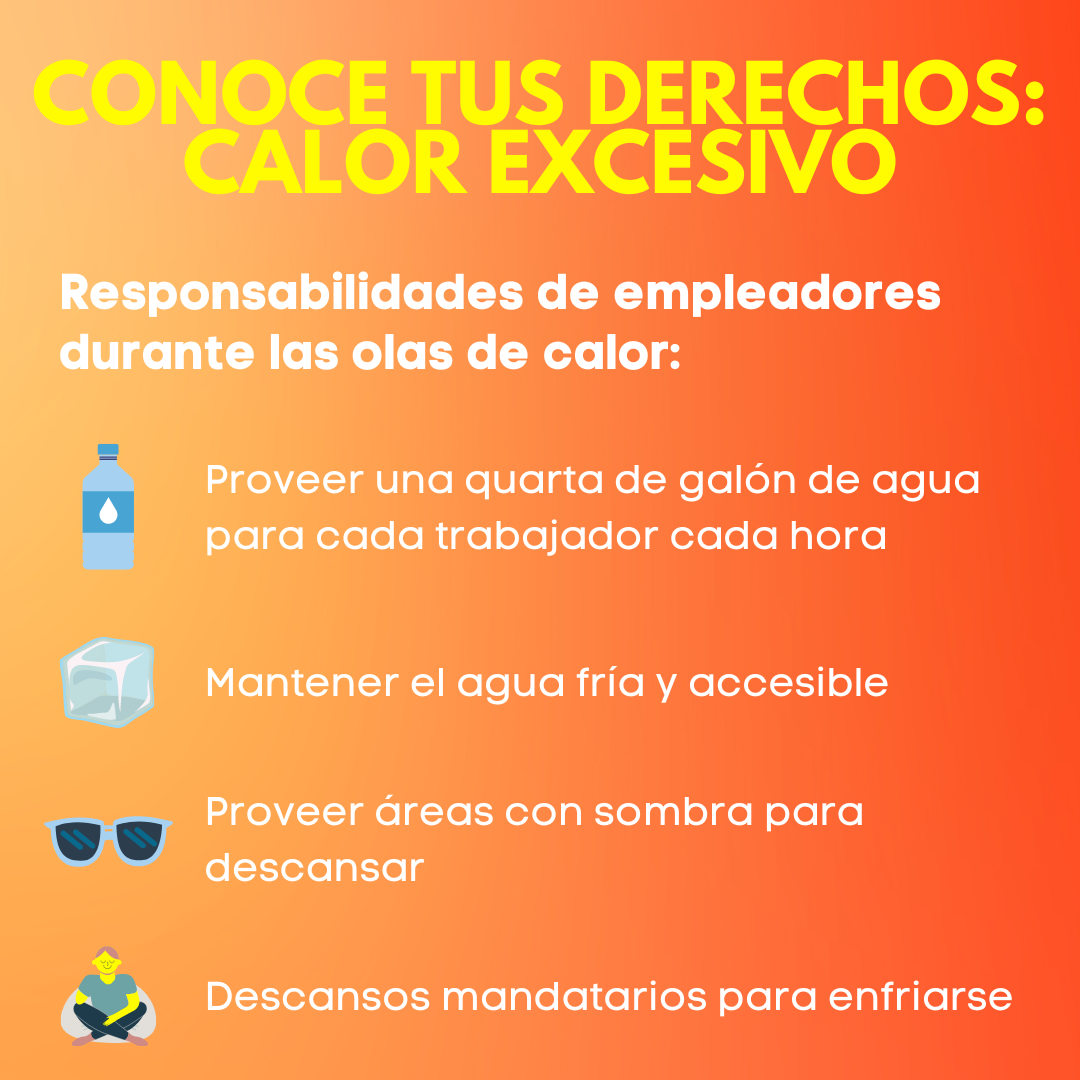
Reglas de salud & seguridad durante las olas de calor

Las temperaturas están llegando a las tres cifras en Yakima, Spokane, y Walla Walla, a los 90s en Seattle y el resto del estado.

Así que es un buen tiempo para revisar las reglas de calor extremo que comienzan a notarse cuando la temperatura llega a 89º+ por más de 15 minutos en una hora.

Responsabilidades de empleadores durante las olas de calor: 

🥤Proveer una quarta de galón de agua para cada trabajador cada hora

🧊 Mantener el agua fría y accesible

🕶️  Proveer áreas con sombra para descansar

🧘 Descansos mandatorios para enfriarse

Más detalles aquí del Departamento de Labor e Industrias de WA. 

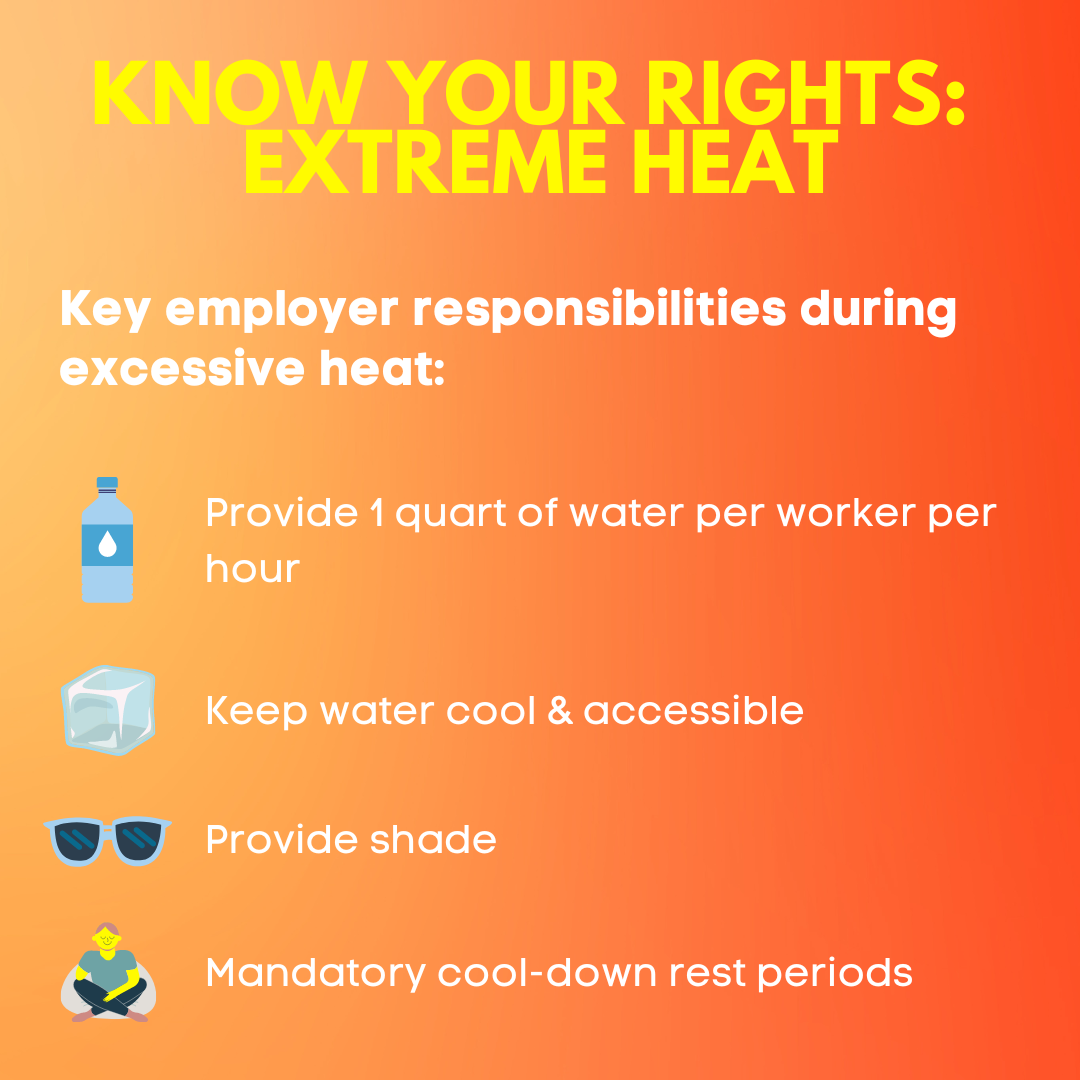
Health & safety rules for WA workers during extreme heat

[Leer esta información en español]

Temperatures are reaching triple digits in Yakima, Spokane, and Walla Walla, and the 90s in Seattle & the rest of the state. 

So it’s a good time to brush up on the outdoor heat exposure rules that kick in for workers exposed to 89º+ temperatures for more than 15 minutes in a 60-minute period. 

Key employer responsibilities during excessive heat:

🥤Provide 1 quart of water per worker per hour

🧊 Keep water cool & accessible

🕶️ Provide shade

🧘Mandatory cool-down rest periods

More details here from the WA Department of Labor & Industries.

Meet Gabo Gutierrez