HE CHOSE TO USE SICK TIME TO CARE FOR HIS FAMILY, THE APP DEACTIVATED HIM: HOW ONE GIG WORKER FOUGHT BACK AND WON

(Español abajo)

“I was doing everything I could to support my family — and then they deactivated me without warning.”
Yelkal, a Seattle area gig worker

Yelkal has driven Seattle’s busy streets for over four years, navigating traffic jams and our unpredictable weather to put food on other people’s tables as well as his own. Like many immigrant gig workers, Yelkal has juggled long hours on the road while working across multiple apps in order to support his growing family. (Delivering meals through apps like Uber Eats, DoorDash, and Grubhub can be challenging at times due to unpredictable order volumes, farflung destinations, and inconsiderate businesses or customers.)

But then, last year, life threw Yelkal a joyful curveball and he and his wife welcomed a newborn child into their family. As any caring partner would do, Yelkal paused his wild schedule to step up and take care of his wife and newborn baby.

His next step should have been simple and straightforward. Gig workers in Seattle came together to win our inclusion in the Paid Sick And Safe Time (PSST) law back in 2023. When Yelkal tried to use his hard-earned sick time through DoorDash in order to have some income during such an important period of his life, they ghosted him. His request seemingly vanished without a trace and was never processed.

The very next day after trying to apply to use his PSST, they threw a gut punch. DoorDash abruptly deactivated his account. The company gave Yelkal a bogus excuse in an attempt to justify what they were doing to him and his family. The company claimed that his offer completion rate had dipped just below their arbitrary 90% threshold.

Baffled by their reasoning for preventing him from taking on more work through their app, Yelkal immediately appealed his deactivation with DoorDash. Yelkal explained the dip in his completion rate, “I wasn’t working because I was helping my wife with the new baby.” If he had been talking to a sympathetic person, his issue would likely have been resolved then and there. But DoorDash? “They didn’t care,” Yelkal said. “They just said their decision was final.”

Yelkal reached out to our team in January for help. Together we formed a plan to most effectively challenge his deactivation. We diligently documented the circumstances around being deactivated and dug deeper into DoorDash’s shady actions, including requesting delivery records to determine which orders had allegedly impacted the order completion rate. In the meantime we filed a complaint with the Seattle Office of Labor Standards (OLS). DoorDash refused to cooperate with even the most basic data about Yelkal’s own delivery history. It shouldn’t have felt like pulling teeth, with weeks passing with DoorDash stubbornly refusing to cooperate. If there’s one thing we know, it is that workers don’t win by backing down. We were persistent and our pressure finally broke through DoorDash’s resistance so that we were able to obtain some documentation which we were able to turn over to OLS.

In March, after almost a full year of being unfairly deactivated simply for trying to care for his family and access a benefit he had a right to by law, Yelkal got good news: DoorDash had reinstated his account. The greedy corporation didn’t just decide to do the right thing. Yelkal spoke up, sought help from other gig workers, and together we were able to strategize and organize to fight for what we deserve.


ELIGIÓ USAR SU TIEMPO DE ENFERMEDAD PARA CUIDAR A SU FAMILIA, LA APLICACION LO DESACTIVÓ: CÓMO UN TRABAJADOR DE APLICACIONES LUCHÓ Y GANÓ

“Hacía todo lo que podía para mantener a mi familia y luego me desactivaron sin previo aviso”. (Traducido de inglés)
Yelkal, trabajador autónomo de Seattle

Yelkal lleva más de cuatro años conduciendo por las calles concurridas de Seattle, sorteando atascos de tráfico y nuestro impredecible clima para poner comida en las mesas de otras personas y en la suya propia. Como muchos inmigrantes que trabajan en aplicaciones, Yelkal ha tenido que hacer malabarismos durante largas horas en la carretera mientras trabajaba en varias aplicaciones para mantener a su creciente familia. (El reparto de comida a través de aplicaciones como Uber Eats, DoorDash y Grubhub puede ser complicado a veces debido al volumen impredecible de los pedidos, los destinos lejanos y los negocios o clientes desconsiderados.)

El año pasado, la vida le lanzó una alegre bola curva y él y su esposa dieron la bienvenida a su familia su bebé recién nacido. Como haría cualquier pareja que se precie, Yelkal hizo una pausa en su alocada agenda para cuidar a su esposa y bebé recién nacido. Su siguiente paso debería haber sido sencillo. En el 2023, los trabajadores de aplicaciones en Seattle nos unimos para conseguir nuestra inclusión en la ordenanza de permisos por enfermedad pagados (PSST, por sus siglas en inglés). Cuando Yelkal trató de utilizar su tiempo de enfermedad que había ganado con tanto esfuerzo a través de su trabajo con DoorDash, para obtener algunos ingresos durante un período tan importante de su vida, lo ghostearon. Su solicitud nunca se procesó y al parecer desapareció sin dejar rastro.

Al día siguiente, le dieron un golpe bajo. DoorDash desactivó bruscamente su cuenta. La compañía le dio a Yelkal una excusa descabellada para intentar justificar lo que le estaban haciéndole a él y a su familia. La compañía alegó que su tasa de finalización de ofertas había caído por debajo de su umbral arbitrario del 90%.

Desconcertado por su razonamiento para evitar que asumiera más trabajo a través de su aplicación, Yelkal apeló inmediatamente su desactivación de DoorDash. Yelkal explicó el descenso de su tasa de finalización: “No estaba trabajando porque estaba ayudando a mi mujer con el nuevo bebé”. Si hubiera estado hablando con una persona compasiva, eso habría resuelto el problema. ¿Pero DoorDash? “No les importó”, dijo Yelkal. “Solo dijeron que su decisión era definitiva”.

Yelkal se puso en contacto con nuestro equipo en enero para pedir ayuda. Juntos elaboramos un plan para impugnar su desactivación de la forma más eficaz. Documentamos diligentemente las circunstancias que rodearon su desactivación y profundizamos en las turbias acciones de DoorDash, incluida la solicitud de registros de entrega para determinar qué pedidos habían afectado supuestamente a la tasa de finalización de pedidos. Mientras tanto, presentamos una queja ante la Oficina de Normas Laborales de Seattle (OLS). DoorDash se negó a cooperar incluso con los datos más básicos sobre el propio historial de entregas de Yelkal. No debería haber sentido como tirar de los dientes, con semanas que pasan con DoorDash obstinadamente se niega a cooperar. Si hay algo que sabemos es que los trabajadores no ganan echándose atrás. Fuimos persistentes y nuestra presión finalmente rompió la resistencia de DoorDash, de modo que pudimos obtener alguna documentación que pudimos entregar a OLS.

En marzo, después de casi un año entero de estar injustamente desactivado simplemente por intentar cuidar de su familia y acceder a una prestación a la que tenía derecho por ley, Yelkal recibió buenas noticias: DoorDash había restablecido su cuenta. La codiciosa corporación no decidió simplemente hacer lo correcto. Yelkal alzó la voz, buscó la ayuda de otros trabajadores por cuenta ajena y juntos pudimos elaborar estrategias y organizarnos para luchar por lo que merecemos.

No More Bogus Deactivations For Gig Workers In Seattle/No Más Desactivaciones Por Excusas Ridículas Para Los Trabajadores De Aplicaciones En Seattle

(Español abajo/Spanish below)

App-based gig workers in Seattle fought to win new protections against unfair deactivations (aka: when app companies like UberEats, Doordash, and Instacart abruptly bar a worker from continuing to work through the app, with no explanation or recourse). Before this law came into effect on January 1, 2025, it was common for app companies to give no notice when they fired workers like this and they also offered no way for the worker to protest their deactivation.

But workers got fed up, got organized, and WON. App companies can no longer hide how they decide whether to deactivate a worker. They must provide us with a policy that states which actions or circumstances may lead to being deactivated from an app. They can’t just make stuff up, either! The rules they come up with have to be reasonable and related to the work we do. Otherwise, they can’t use them as an excuse to kick us off an app.

As part of our protections, in most cases app companies must not shut off our access to work on their app without 14 days notice. Unlike in the past, when a company deactivates an account they have to provide a reason for doing so and include information like the specific incident that violated the company’s deactivation policy. App companies must also provide a way to challenge a deactivation and, just as importantly, they have to explain to us how to do it! Once we challenge a deactivation directly through the app company, we also have the right to file a complaint with the Seattle Office of Labor Standards.

Want to know more about our protections under the Deactivation Rights ordinance? Come to our next monthly info session! Together, we can ensure that these rights aren’t just words on paper and ensure that Seattle is the best city to do gig work.


Los trabajadores de aplicaciones en Seattle luchamos para conseguir nuevas protecciones contra las desactivaciones injustas (también conocido como cuando empresas de aplicaciones como UberEats, Doordash e Instacart bruscamente impiden a un trabajador seguir trabajando a través de su aplicación, sin explicación ni recurso). Antes de que esta ley entrará en vigor el 1 de enero de 2025, era habitual que las empresas de aplicaciones no dieran aviso cuando despidieran a los trabajadores de su aplicación y también no ofrecían ninguna forma de que el trabajador protestará por su desactivación.

Pero los trabajadores nos hartamos, nos organizamos y GANAMOS. Las empresas de aplicaciones ya no pueden ocultar cómo deciden si desactivan a un trabajador. Deben proporcionarnos una política que establezca qué acciones o circunstancias pueden llevar a la desactivación de una aplicación. ¡Tampoco pueden inventarse las cosas! Las normas que establecen tienen que ser razonables y estar relacionadas con nuestro trabajo. Si no, no pueden utilizarlas como excusa para despedirnos.

Como parte de nuestras protecciones, en la mayoría de los casos las empresas de aplicaciones no deben impedirnos el acceso a trabajar en su aplicación sin avisarnos con 14 días de antelación. A diferencia de lo que ocurría en el pasado, cuando una empresa desactiva una cuenta debe justificarlo e incluir información como el incidente concreto que infringió la política de desactivación de la empresa. Las empresas de aplicaciones también deben ofrecer un proceso para protestar la desactivación y, lo que es igual de importante, !que nos expliquen como hacerlo! Después de protestar la desactivación directamente a través de la empresa de aplicaciones, también tenemos derecho a presentar una queja ante la Oficina de Normas Laborales de Seattle (Seattle Office of Labor Standards, en inglés).

¿Quieres saber más sobre nuestras protecciones bajo la ordenanza de derechos de desactivación? ¡Únete a nuestra próxima sesión informativa mensual! Unidos podemos asegurar que estos derechos no se queden en papel mojado y que Seattle sea la mejor ciudad para trabajadores de aplicaciones.

Fighting for Justice: A Domestic Worker’s Victory and Why We Need a Bill of Rights

In Washington state, thousands of domestic workers—nannies, house cleaners, and caregivers—work without the most basic labor protections. Many face wage theft, unfair working conditions, and employer exploitation. Seattle workers won the Seattle Domestic Workers Ordinance that establishes overdue protections for domestic workers in the city, but workers statewide still lack clear, enforceable rights—which is why we are fighting for a Washington Domestic Workers Bill of Rights.

Recently, our legal team at Working Washington and Fair Work Center represented a domestic worker in a case that highlights why these protections are so urgently needed.

This worker, referred to our legal team through Casa Latina, had recently immigrated from Honduras. She and her adolescent daughter were living in a women’s shelter while she tried to establish financial stability. Like many domestic workers, she faced unpredictable work schedules, no guaranteed wages, and no labor protections.

Throughout her employment, her employer denied her rest breaks—a violation of Seattle labor laws. When she needed to take legally protected sick time, her employer denied this. Additionally, the employer offered to loan her money for car repairs but charged exorbitant, undisclosed interest, trapping her in a cycle of debt. Ultimately, the instability of the job forced her to step away voluntarily.

When our legal team got involved, we helped the worker calculate her damages, which included:

  • Missed meal and rest breaks
  • Recovering the unfairly charged interest from the loan
  • Penalties for being denied protected sick time

She initially sought $9,500 in damages, but penalties for the employer’s violations pushed her case above the $10,000 cap for small claims court. After sending a demand letter, the employer hired a lawyer and attempted to intimidate her—a common tactic used against immigrant workers. But with legal support and persistence, she secured a $15,000 settlement, enough to move her family into stable housing.

The Bigger Picture: Why We Need a Domestic Workers Bill of Rights

This case is a hopeful story, but no worker should have to go through this just to claim their basic rights. Employers exploit the vulnerabilities of immigrant workers, using fear and misinformation to prevent them from speaking out. But the truth is that all workers—regardless of immigration status—have rights.

If the Washington Domestic Workers Bill of Rights were in place, this worker wouldn’t have had to fight for what she deserves, such as:

✅ Paid sick leave

✅ Overtime pay

✅ A guaranteed minimum wage

✅ The right to rest breaks

Domestic workers play a vital role in our economy and communities. It’s time we recognize their work and pass this bill to ensure they are treated with the dignity and fairness they deserve.

Take Action

Our fight isn’t over. Join us in pushing for a Domestic Workers Bill of Rights in Washington! Here’s how you can help:

📢 Share this story to raise awareness.

📞 Call your legislators and tell them to support worker protections by passing Senate bill 5023

Together, we can ensure no domestic worker is left unprotected.

10 Years of Worker Wins: Seattle’s Fight for Fair Wages

Today, we celebrate a decade of worker power! In 2015, Seattle’s Minimum Wage and Wage Theft Ordinances took effect—raising wages, holding bad employers accountable, and setting a national standard for worker protections.

The Impact

✅ $16 million recovered for nearly 10,000 workers

✅ Minimum wage increased from $9 in 2014 to $20.76 today

✅ 6,000+ workers won back stolen wages through wage theft enforcement

These victories didn’t happen by chance—they happened because workers organized, took action, and fought for fairness.

Today, Seattle’s minimum wage stands at $20.76 per hour, showing just how far we’ve come in the fight for fair pay. But the work isn’t over—bad employers still attempt to undercut workers, and we must remain vigilant to defend and expand these hard-fought gains.

The Fight Continues

As our Executive Director Danielle Alvarado says:

“Winning the Fight for $15 was just the beginning. Strong enforcement ensures our victories keep putting money back in workers’ pockets and building a fair economy for all.”

Seattle’s worker movement is proof: when we organize, we win. This milestone is not just about celebrating the past—it’s about fueling the movement for our future. 

As we look ahead, we must continue the fight to strengthen enforcement, expand protections, and ensure that all workers—especially those in historically excluded industries like domestic work and gig work—are treated with the dignity we deserve.

Let’s keep pushing for justice in every workplace!

View a Press Release commemorating this anniversary by the Seattle Office Of Labor Standards.

WASHINGTON STATE SENATE ADVANCES THE DOMESTIC WORKERS BILL OF RIGHTS, WORKERS REACT

For Immediate Release: March 5, 2025

Contact: Hannah Sabio-Howell | hannah@workingwa.org, (206) 573-2317

Washington state takes a major step toward becoming the thirteenth state in the nation to end the exclusions that shut domestic workers out of minimum wage, sick time, overtime, and other basic labor standards

Following news of the victory, domestic workers speak to the importance of including the industry in fair workplace standards

Seattle, WA – The Washington state Senate today approved a bill to end the historic exclusions of domestic workers from basic, common-sense labor standards such as minimum wage, sick time, and protection from discrimination.

Going back to the dawn of the New Deal, the domestic work industry – made up mostly of immigrants and women of color, then and now – has been legally excluded from the labor standards that ensure stability and prosperity for Washington families. As a result, an estimated 100,000 workers in our state labor in the shadows, often making subminimum wage, working without proper breaks, and feeling unable to speak up for themselves.

Key elements of the policy approved by the Senate today include:

  • Wage and Hour Standards: Establish the right to minimum wage, overtime pay, meal and rest breaks, and notice of termination for domestic workers.

  • Sick Time: End the exclusion of domestic workers from the current state sick time law.

  • Anti-Discrimination & Anti-Retaliation: Prohibit discrimination, harassment, and retaliation based on protected characteristics, including immigration status; remove eight-employee minimum for domestic worker employers; and provide additional protections specific to domestic workers, such as prohibiting the seizure of personal documents and monitoring of private activities.

  • Written Agreements & Record-Keeping: Require written employment agreements and record-keeping of hours, wages, and other employment terms; require “reasonable time” for a worker to review the agreement and to have it translated into the language they understand.

  • Enforcement: Grant authority to the Department of Labor & Industries to investigate complaints, issue citations, and collect unpaid wages; establish private right of action, and create community/agency partnerships to ensure robust and culturally competent enforcement.

Twelve other states, including Oregon and California, have passed a statewide Domestic Workers Bill of Rights, including several major cities across the country. It is more important than ever that all Washington workers get the pay and dignity they are owed. Washington’s economy is the strongest in the nation for a reason – we have worked hard to raise wages and workplace standards for millions, but domestic workers have been left out of that growth. It’s time we make our economy truly inclusive by raising standards for this largely immigrant workforce that sustains so many working-class families and families of color.

The bill now advances to the Washington state House for consideration. If passed, domestic workers across Washington would finally be eligible for the same basic labor standards that workers in most other industry rely upon for stability and dignity in the workplace.

Comments from workers are included below. Contact Hannah Sabio-Howell to arrange an interview.


“Our work is physical, emotional and essential, but many of us still face abuse due to lack of information and enforcement of existing laws. It is crucial that employers have guidance on our rights and that the use of contracts is mandatory to ensure fair conditions.” – Elena Echeverría, cleaner

Many endure sudden cuts to their hours without notice, withheld wages, and the inability to take sick leave out of fear of losing their jobs. Passing this law is critical to expanding the rights of domestic workers and ensuring dignity and fairness for everyone in this profession.” – Lisbeth Herrera, nanny

“During the week I take care of a baby that I adore. Her moms, a pediatrician and a surgeon, are able to focus on their patients because of my work. Yet as essential as my work is, I do not have access to basic rights such as health insurance. We face risks every day: physical injuries, illnesses transmitted by children, or health problems from the chemicals we use when cleaning. Without the rights in the Domestic Workers Bill of Rights, the well-being of our families and those we care for is at risk.” – Jael Cuellar, in-home caregiver

Fair Work Center to King County Small Claims Court: Prioritize Language Accessibility and Access to Justice

On August 21st, the Fair Work Center, along with 11 other signatories, sent an advocacy letter to the King County District Court’s Small Claims Division to highlight significant language barriers our clients have faced in accessing the Court and to request that the Court works with us and community partners to address it. The present language barriers pose serious access to justice concerns and have had a disproportionate impact on marginalized communities. For many workers, Small Claims Court is their best option to recover stolen wages and it is essential that everyone, regardless of the language they speak, have access to the courts.

A few examples of issues our clients have faced include, but are not limited to,

  • Difficulties filing the initial small claims court complaint because many of the required court forms are only available in English and the few forms that are translated are difficult to locate on the website. Further, the option of filing online is impossible for non-english speakers because the portal is exclusively in English.
  • Workers received instructions relevant to their case entirely in English despite indicating that they required interpretation in a different language. In one case, because the worker could not understand the notice they received, they missed an important deadline in their case.
  • Workers have had less-favorable outcomes in their cases, and in one instance, their case was dismissed, because the Court failed to provide an interpreter and the worker had to navigate the hearing without one.

The above examples highlight a few of the reasons why we wrote this advocacy letter to the Court. Our goal is to elevate these concerns to the Court and to work with them and community partners to enhance language access. We are committed to continuing to fight for more just outcomes for all workers in Washington State, regardless of what language they speak.

CELEBRATING 7 YEARS OF SEATTLE’S SECURE SCHEDULING ORDINANCE!

Seven years ago workers across the food service and retail sectors got fed up with being treated by our corporate employers as if we exist solely to serve at the beck and call of our boss. Having no predictability or flexibility at work made it impossible to live our lives — raise kids, have a vacation, be creative, enjoy other opportunities. So, we fought for Seattle’s first-ever secure scheduling ordinance, and today we celebrate seven years of a worker-won policy that gives us some breathing room. And thanks to the Office of Labor Standards, workers have held employers accountable to the law and put nearly $10 million back in workers’ pockets. Here’s to the next seven and many more!

“The principle behind secure scheduling is clear: workers are people. Workers have lives away from work. We all have a right to know when we’re going to work and how many hours we’re going to get. We’re proud to celebrate seven years of our nation-leading secure scheduling law that holds large corporate employers accountable to this principle and grants workers greater stability and joy both inside and outside of work.”

— Danielle Alvarado, Executive Director | Working Washington & Fair Work Center

How does secure scheduling work?

  • Employers must post work schedules at least 14 days in advance, and respect employees’ right to decline any hours not on originally posted schedules.

  • Employees are entitled to time-and-a-half pay for any hours worked between closing and opening shifts that are separated by less than 10 hours.

  • Employers must provide a written good faith estimate of median hours employees can expect to work and whether employees will work on-call shifts to new employees at the time of hire, and to current employees on an annual basis and when there is a significant change to employees’ schedules.

And more! Read more about the policy here.

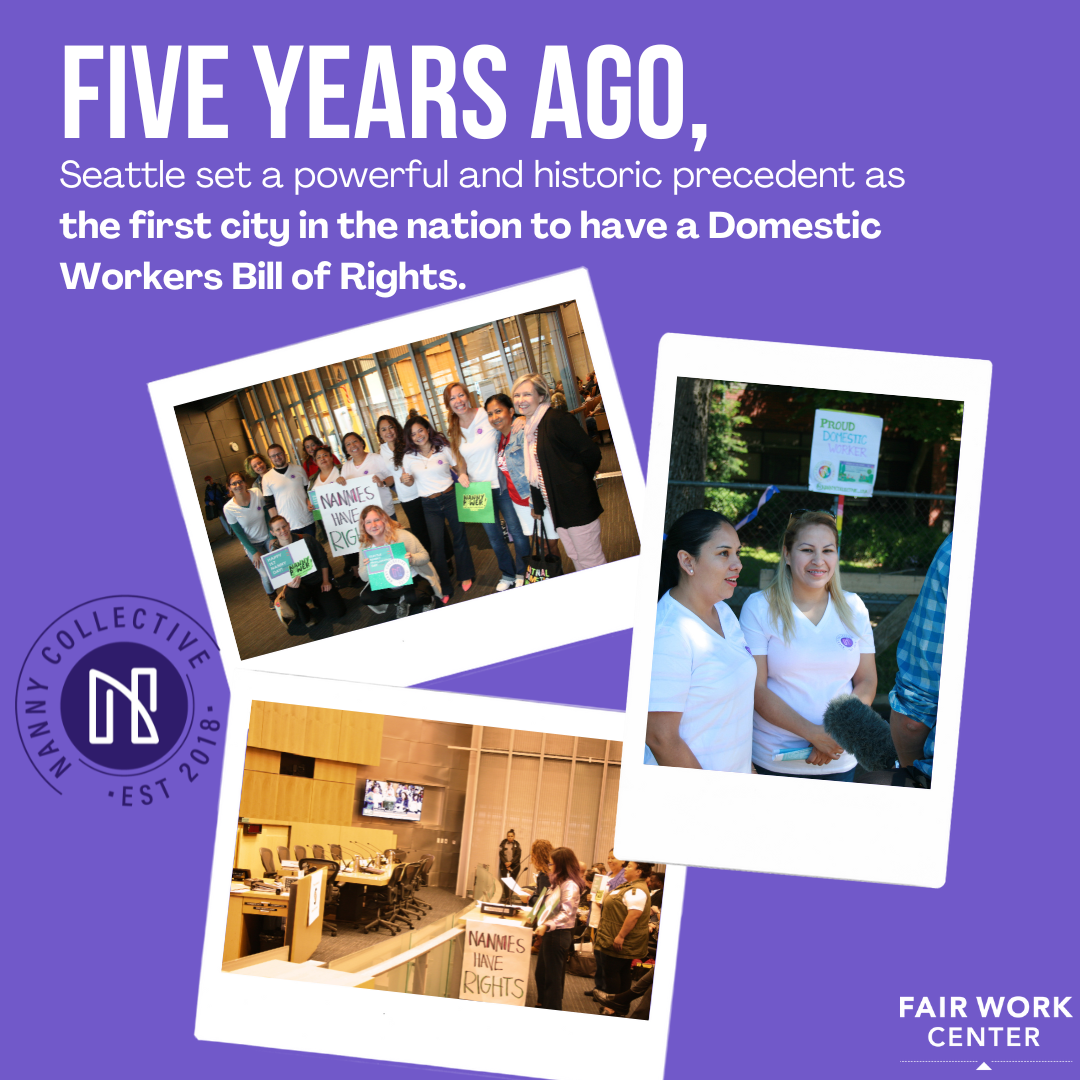
5 Year Anniversary of The Domestic Workers Bill of Rights


Celebrating five years!

Five years ago the city of Seattle set a powerful and historic precedent as the first city in the nation to have a Domestic Workers Bill of Rights. 

Who is a domestic worker?
Domestic workers are those who provide paid services to an individual or household in a private home as a nanny, house cleaner, home care worker, gardener, cook, and/or household manager. These workers have been historically excluded from the same rights other workers have long enjoyed.

What does it do? 

The Domestic Worker Ordinance establishes:

  • Minimum wage for domestic workers
  • Provision of meal periods
  • Rest breaks
  • The right to keep personal documents.
  • Establishing the Domestic Worker Standards Board (DWSB)

Who made it happen: 

None of this would have happened without the tireless efforts of the Nanny Collective, along with worker champion Teresa Mosqueda, and our community partners Casa Latina, Hand in Hand, National Domestic Workers Alliance, and friends in the labor community!

La lucha sigue: 

The fight continues! Today, we celebrate; tomorrow, we press on to make this ordinance cover exploited domestic workers all over the state of Washington. Although Seattle was the first city to have such an ordinance, eleven states have also now enshrined domestic worker protections, and Washington must do the same.


How can I help? 

  • Follow the Nanny Collective on Facebook and Instagram
  • Donate to Fair Work Center and empower your domestic worker neighbors in Washington state.
  • Come celebrate with us! We’ll be gathered at Pratt Park (201 20th Ave S, Seattle, WA 98144) on Monday July 1st from 5pm-8pm. Refreshments and activities will be provided! Children and families are all welcome as we mark this historic milestone.


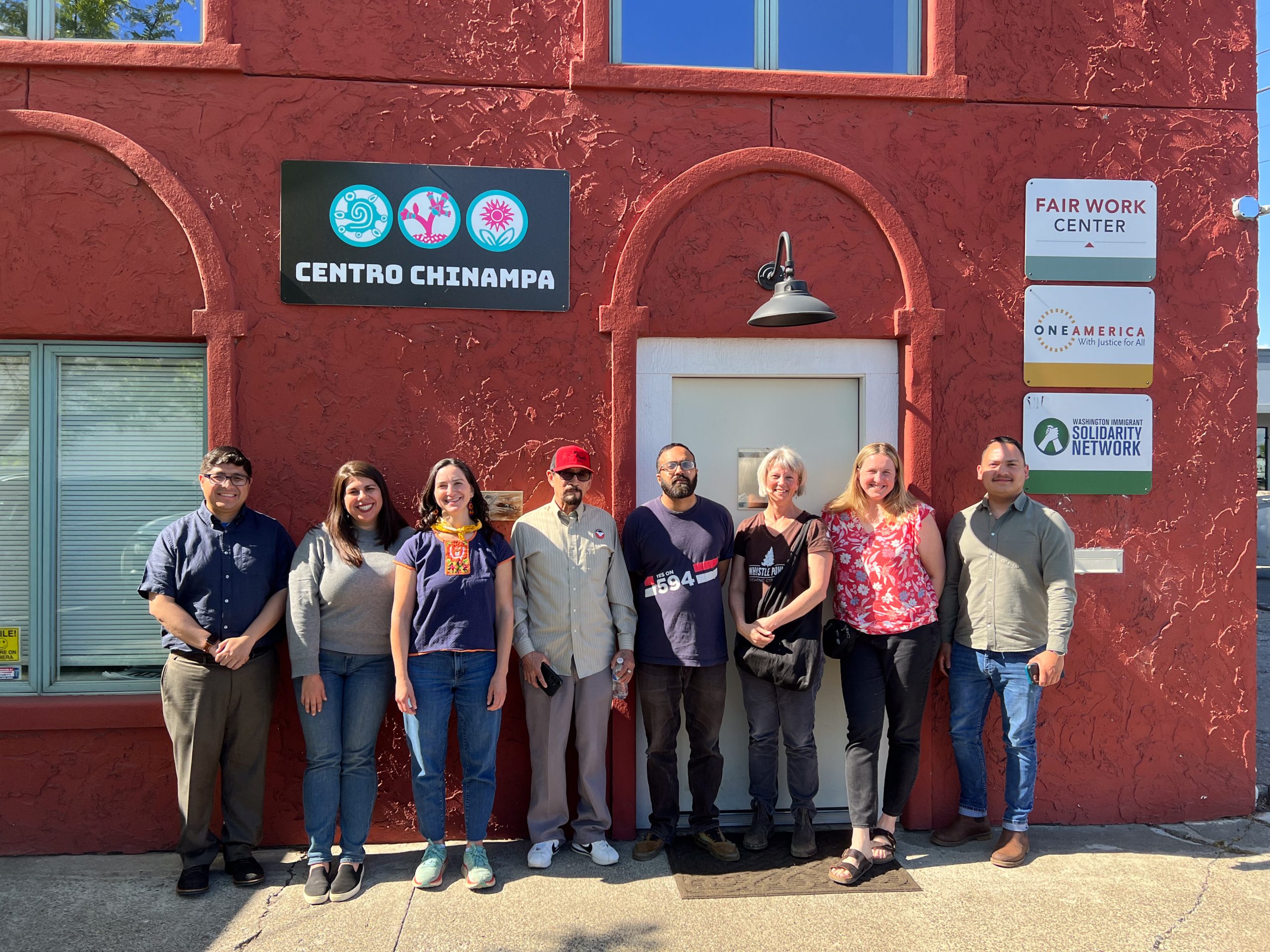
Felicidades Centro Chinampa!

This month we celebrated the 2-year anniversary of Centro Chinampa! This center has been our community space in Yakima where we organize with bodega workers, hold legal intake clinics, host Know Your Rights events with our friends at the Washington Immigrant Solidarity Network, and build community together. 

Centro Chinampa is where workers have taken effective action to make our workplaces safer, healthier, and more humane. We have shared our stories of retaliation, mistreatment, and untenable workplace conditions – and how we fought back together and won. We have gathered around the table to share food and information about our rights at work. We have made meaningful progress in an agricultural industry that was built around the exploitation and neglect of the very people who make that industry possible.

Happy 2nd birthday to Centro Chinampa and thank you to all the workers who have brought life and solidarity into the space.


Este mes celebramos
el segundo aniversario del Centro Chinampa. Este centro ha sido nuestro espacio comunitario en Yakima, donde nos organizamos con los trabajadores de las bodegas, realizamos clínicas de admisión legal, organizamos eventos de Conoce tus Derechos con nuestros amigos de la Red de Solidaridad con los Inmigrantes de Washington, y construimos comunidad juntos. 

El Centro Chinampa es el lugar donde los trabajadores han emprendido acciones eficaces para hacer que nuestros lugares de trabajo sean más seguros, más saludables y más humanos. Hemos compartido nuestras historias de represalias, malos tratos y condiciones laborales insostenibles, y cómo hemos luchado juntos y hemos ganado. Nos hemos reunido en torno a la mesa para compartir alimentos e información sobre nuestros derechos en el trabajo. Hemos logrado avances significativos en una industria agrícola que se construyó en torno a la explotación y el abandono de las mismas personas que hacen posible esa industria.

Feliz 2º cumpleaños al Centro Chinampa y gracias a todos los trabajadores que han dado vida y solidaridad a este espacio.