For Immediate Release:
Sep. 12, 2025

Contact: Hannah Sabio-Howell | hannah@workingwa.org, (206) 573-2317

Adult Family Home workers seek to end unjust labor protection exclusions

Fair Work Center, on behalf of workers, to argue before Washington Supreme Court that exclusions from minimum wage rights for live-in care workers are unconstitutional

A Washington Supreme Court ruling in favor of workers could lead to a broader legislative action nullifying the live-in exemption and expanding coverage of fundamental labor standards to thousands of low-wage Washington workers

Olympia, WA – The Washington Supreme Court on Tuesday will hear oral arguments, presented by Fair Work Center Legal Director Jeremiah Miller, on the case of Bolina et al v. Assurecare, LLC asserting that the 64 year old exemption of live-in care workers from bedrock labor protections is unconstitutional.

The Case

Fair Work Center will be representing six workers formerly employed by several Adult Family Homes (AFHs) run by Assurecare. The workers – Ms. Bolina, Mr. Payag, Ms. Ocampo, Ms. Robles, Mr. Castillo and Mr. Villalobos – came to Fair Work Center in 2022 with horrific reports of workers’ rights abuses. The workers often worked shifts that were 24 hours long, without uninterrupted breaks or sleep, resulting in injuries and infections like COVID-19. The impact of these injuries and illnesses on these caregivers was compounded by their lack of access to sick leave. For this back-breaking labor, they were paid a flat daily rate regardless of how many hours they worked, amounting to as little as four dollars per hour with no overtime pay.

This experience for live-in care workers at AFHs is common. Though Washington is, in many ways, a national leader in protecting workers’ rights, the backbone of our state’s labor laws (the

Minimum Wage Requirement and Labor Standards Act, also known as the MWA) is fundamentally shaped by flawed federal laws. It contains unexplained exemptions to various labor protections for many categories of workers, including workers who live where they work.

The History

Accordingly, the MWA exempts “[a]ny individual whose duties require that [they] reside or sleep at the place of [their] employment…” from its protections. This exclusion derives from a shameful tradition in the United States denigrating the value of domestic work (including caregiving work), and the explicit exclusion of work that is performed by non-white, non-male identifying people from foundational labor laws.

The federal government in the 1930s enacted groundbreaking worker protections in the form of various “New Deal” laws, including the National Labor Relations Act, the Social Security Act, and the Fair Labor Standards Act. But these laws explicitly or implicitly excluded domestic workers and agricultural workers, part of a pattern of systematic and intentional exclusion of Black and female workers from all major New Deal legislation. As a tool for advancing overtly discriminatory interests, drafters used facially neutral categorical exclusions as proxies for excluding Black and female labor forces from the New Deal. The goal was simple: maintain the existing social hierarchy and prevent Black and female workers from gaining political power. Echoes of these decisions were codified in Washington law, with little or no discussion, in the 1960s.

The Impact

For live-in care workers today, these exemptions allow AFH employers to create work conditions that would be illegal for most workers, including other caregivers doing identical work, who do not live where they provide care. Wages on the order of a few dollars per hour, no breaks, and no access to state-protected sick leave are conditions that no worker should face. The very idea that “living-in” somehow makes a worker less deserving of protection cannot be separated from the social, cultural, and political contexts that have informed the way society devalues labor performed in the “domestic” sphere. It is time we shed the deeply racist and sexist thinking that never had any place in our country’s labor laws and certainly doesn’t today.

The Possible Outcome

Fair Work Center on Tuesday will seek a judgment from the Washington State Supreme Court that declares the live-in exemption to the MWA unconstitutional. If successful, this decision would follow on the heels of a 2020 decision (Martinez-Cuevas et al. v. DeRuyter Bros. Dairy Inc.) in which the Washington Supreme Court determined that excluding workers in dangerous jobs from the MWA violates the Washington Constitution’s unique Privileges and Immunities Clause. As a result, the Washington state Legislature ended the overtime exemption for all agricultural employees. Fair Work Center’s case could similarly extend these constitutional protections to live-in caregivers, who are overdue for access to minimum labor standards.

Comments from plaintiffs and legal experts are included below. Contact Hannah Sabio-Howell to arrange an interview.


“Justice is slow, but I’m glad we made it to this point. I hope the Court listens to the experiences of workers in this job. This job isn’t easy, and you don’t get compensated much. You’re there 24/7, taking care of up to six people at the same time that all have different needs, exposed to diseases or possible back injuries every day, with no health benefits or the right to a 401k. I hope we come away with laws that protect us and that other Adult Family Care workers learn we deserve more.” – Hollee Christian Castillo, plaintiff


“The courage of the six workers I have the honor of representing is emblematic of the tenacity and commitment of this entire industry of workers. Adult Family Home workers care for elders and disabled loved ones day in and day out, and, since the creation of Adult Family Homes in the late 1980s, have worked in one of the few industries exempted from the right to fair pay and safe workplaces. It’s time for this shameful legacy in our labor laws to end in Washington state.” – Jeremiah Miller, Legal Director


FOOD DELIVERY APPS TRY TO EXPLOIT GIG WORKERS WHO DON’T KNOW OUR RIGHTS

(Español abajo) 


In 2023, Nicole was a gig worker delivering groceries through Instacart. One day while on the job, she injured her foot. She couldn’t keep shopping for the order or continue the delivery because of the condition and her pain. She requested to use her paid sick leave. Despite the clear legal protections that applied to her situation, the app refused to approve Nicole’s request to use her paid sick leave. 

While Nicole was already in pain, the app caused her more. Nicole appealed the app’s denial of her sick leave, but instead of addressing it the app shut down her account altogether. The app’s obscure algorithms probably calculated that it was more profitable to just not deal with the appeal and avoid paying Nicole the sick leave she was owed. Shutting down Nicole’s account also meant that even when she was better and able to walk and work without pain, she wouldn’t be able to accept new job offers through the app and she would not be able to earn the money she needed to pay the bills and put food on her own table. 

Apps and their obscure algorithms do this kind of retaliation all the time. Nicole’s unfair experience unfortunately isn’t unique at all. An app’s algorithm determines that it is cheaper to screw over workers and hope we’ll fold than it is to do right by the workers who make the company so profitable in the first place. That way the app sucks up more money by not paying the very workers that do work through the app. 

Nicole reached out to Working Washington/Fair Work Center for help and together we made a plan to fight back against the app’s crazy actions. Through persistent pressure and legal advocacy, we forced the app to choose to negotiate a settlement. In the end, Instacart paid Nicole not just for the sick days she was entitled to take but also a substantial payout for the retaliation the app inflicted on her. 

When workers like Nicole organize and fight back, we can raise standards in the industry and affect the apps’ calculations about whether it is worth it to violate the rights of the next worker who asked for what they’re owed. Gig work shouldn’t mean giving up our right to safety, fair pay, or respect. Standing up against these mega rich apps is how we win what we’re owed, but first we have to know what our rights are and how to fight back. 

This is why it is important that community organizations like Working Washington/Fair Work Center and government agencies work together to do outreach and education to app workers. The Seattle Shield initiative that voters will get to decide on in November will create dedicated funding for Seattle’s Office of Labor Standards, the city’s most important agency for educating workers on our rights and enforcing them. Let’s make sure we all vote YES, so that we have another tool to help us fight for what we’re all owed.

LAS APLICACIONES GANAN MÁS NEGÁNDONOS A LOS TRABAJADORES DE APLICACIONES CUANDO NO SABEMOS NUESTROS DERECHOS

En 2023, Nicole era trabajadora de reparto a través de la aplicación Instacart. Un día, mientras trabajaba, se lesionó el pie. Por su condición y dolor ya no pudo seguir comprando para el pedido ni hacer la entrega. Intentó usar sus días de enfermedad pagados. Aunque las leyes claramente protegían su derecho a usarlos, la aplicación lo negó.

Y como si el dolor físico no fuera suficiente, la aplicación le causó aún más. Nicole apeló la decisión negándole sus días de enfermedad, pero en lugar de atender su caso, la aplicación simplemente cerró su cuenta. Lo más probable es que los algoritmos de la aplicación decidieron que se podía quedar con más dinero ignorando la apelación para no tener que pagarle a Nicol los días que le correspondían. Al cerrarle la cuenta, la aplicación también se aseguró de que, incluso cuando Nicole se sintiera mejor y pudiera volver a trabajar sin dolor, no pudiera aceptar nuevos pedidos para generar ingresos para pagar sus cuentas ni poner comida en su propia mesa. 

Las aplicaciones y sus algoritmos oscuros hacen este tipo de represalias todo el tiempo. Lo hacen porque es parte de su modelo de negocio negarnos lo que nos deben y confiar en que no sabemos cómo defendernos. Esa estrategia les permite llenarse los bolsillos al no pagarnos a los trabajadores de reparto.

Nicole busco apoyo con Working Washington/Fair Work Center, y juntos hicimos un plan para enfrentar a la aplicación por lo que estaba haciendo. Con presión constante y apoyo legal, obligamos a Instacart a negociar. Al final, no solo le pagaron a Nicole los días de enfermedad que tenía derecho a tomar, también ganó una compensación significativa por las represalias que sufrió. 

Lo que vivió Nicole no es nada nuevo. Las aplicaciones saben que si hacen algo injusto, muchos trabajadores no conocemos nuestros derechos ni que hacer. Así se llenan los bolsillos por dejar de pagarle a la misma gente que trabaja por la aplicación lo que merecemos. 

Pero cuando trabajadores como Nicole nos organizamos con otros trabajadores de aplicaciones y luchamos, podemos cambiar las reglas del juego. Podemos hacer que las aplicaciones ya no les salga tan barato ignorar nuestros derechos. Trabajar por aplicaciones no debe significar renunciar a la seguridad, pago justo, ni respeto. Luchar contra estas aplicaciones super ricas es como podemos recuperar lo que nos deben. Pero primero hay que saber cuales son nuestros derechos y cómo exigirlos. 

Por eso es tan importante que organizaciones comunitarias como Working Washington/Fair Work Center y agencias del gobierno trabajemos para educar y apoyar trabajadores de aplicaciones. La propuesta ley Seattle Shield, que estará en la boleta electoral este noviembre, creará fondos dedicados para la Oficina de Normas Laborales de Seattle, una agencia clave que educa a trabajadores sobre nuestros derechos y hace que se respeten. Hay que asegurarnos de votar Sí . porque esta propuesta nos da otra herramienta para exigir lo que merecemos.

Claiming Farm Worker Power On The Mega Farm/Reclamando el Poder de los Trabajadores Agrícolas en la Mega Granja

(Español abajo)


Imagine toiling outdoors under the scorching sun to put food on the table and, despite your hard work, being attacked by the boss for who you are. Then imagine organizing with your coworkers to make a plan to fight back, and not only win a six-figure settlement but also use your power to make sure that the company makes meaningful changes to prevent any other worker at the company from being mistreated so terribly! That’s organizing.

In the summer of 2022, a group of 7 apple orchard workers at Borton, one of the mega farms in Yakima, began sharing experiences with each other and realized that a crew leader was mistreating each one. The boss demeaned some workers for being women, for having darker complexions, for appearing to have indigenous ancestry, and based on religion. Older workers, who brought years of experience to the orchard and were trying to do their job well, were berated for working too slowly for the boss’ liking. Anyone who dared to raise a complaint was punished for it. It’s a textbook case of abuse wrapped in a very thin disguise of “management.”

The whole system that some bosses rely on to make money is built around keeping workers divided. It’s not a glitch in the system or an oversight, it’s their strategy. They like pitting men against women, younger workers against older, white workers against people of color, workers with experience over new workers…you’re catching on, there are a lot of ways they like to do it! Why? They know that divided workers have a harder time organizing together to demand what we deserve!

Unfair bosses depend on division, fear, and a culture where workers keep our heads down because that allows the supervisor, the owner, and the corporations (all of them bosses) to squeeze every last profit from our hard work. Sometimes a company will do it as an order from the top, sometimes it will do it by intentionally turning a blind eye while an underling, like a crew leader, abuses their position. Either way, the boss does it on purpose to keep workers from coming together, speaking up, and demanding fair treatment and fair pay.

When the orchard workers at Borton started talking with each other, they had a realization: there are more workers than the boss and that means that together we have more power. Then a plan was organized through the Fair Work Center and the workers decided that the next step was to file legal charges against Borton through the Equal Employment Opportunity Commission (EEOC), a government agency that helps workers protect ourselves from unfair treatment and discrimination at work. It can be an important legal tool to fight for what we deserve. The EEOC offered a chance to use mediation to resolve the charges and the orchard workers insisted that they would not be divided and only agreed to go through the process together as a group.

At the mediation the company made absurd excuses for discriminating against the very workers who made them money. When it was their turn, the workers spoke out about being mistreated by the company and about being retaliated against for trying to do something about it. Even as the company continued to disrespect the orchard workers with their arguments, the workers stayed strong. After the mediation the company agreed to settle the charges with the seven workers.

Borton offered to pay the workers a six-figure settlement, but the workers did not accept the offer until the company agreed to take meaningful steps to prevent any other worker at the company from being mistreated so terribly. It was a deliberate choice to do that and not treat settlement negotiations as just a way to resolve the group’s specific charges. It was a way to win real improvements for all the workers at the company. By organizing together and making a plan, the workers improved the conditions in the workplace and won $200,000 for their trouble.

As part of the workers’ demands, the company agreed to pay for separate training sessions about its obligation to not discriminate against any workers, one for its managers and for the workers. The workers also got the company to agree to:

Improve complaint procedures so that in the future workers are protected from retaliation.
Explicitly agree that workers can make complaints outside of the normal chain of command, which is especially important when a worker’s direct supervisors are mistreating them.
Give workers a stronger voice in the company’s health and safety decisions.
Improve workers’ access to the restrooms.
Ensure workers get uninterrupted breaks.
Ensure workers participate in company safety and health committee meetings.

Bosses may want to continue running the orchards (and all our workplaces) like their own little kingdoms but, when workers come together to organize, the boss can’t continue to pretend they get to call all the shots. It’s long past time that we stop keeping our heads down and letting the bosses make us feel small and vulnerable. Together, we have the power to make our workplaces better, to ensure that we get treated fairly, and fight for what we deserve.


(English above)

Imagina trabajar bajo el sol quemante para llevar comida a tu casa y, a pesar de todo tu esfuerzo, que el jefe te ataque por quién eres. Ahora imagina que te organizes con tus compañeros para hacer un plan para defenderte, y que no solo ganen una demanda millonaria, sino que usen su poder para asegurarse de que la empresa haga cambios reales para que ningún otro trabajador sufra ese trato tan injusto. Eso es organizarse.

En el verano de 2022, un grupo de 7 trabajadores en un huerto de manzanas en Borton, uno de los mega productores en Yakima, empezó a platicar y se dieron cuenta que un líder de equipo los estaba maltratando a todos. El jefe humillaba a algunas personas por ser mujeres, por tener piel más oscura, por parecer tener ascendencia indígena, y por su religión. A los trabajadores mayores, que tenían años de experiencia y se esforzaban por hacer bien su trabajo, los regañaban por hacerlo “muy lento” para el gusto del jefe. Quienes se atrevían a quejarse, eran castigados. Es un caso típico de abuso disfrazado de “administración”.

El sistema que usan algunos jefes para ganar dinero está hecho para dividir a los trabajadores. No es un error ni un accidente, es su estrategia. Les gusta enfrentar a hombres contra mujeres, a jóvenes contra mayores, a trabajadores blancos contra personas de color, a los que tienen experiencia contra los nuevos… seguro ya entiendes, hay muchas maneras. ¿Por qué? Porque saben que si los trabajadores estamos divididos, nos cuesta más organizarnos para exigir lo que merecemos.

Los jefes injustos se apoyan en la división, el miedo y en una cultura donde los trabajadores mantenemos la cabeza baja, porque así el supervisor, el dueño y las empresas (todos ellos jefes) pueden exprimir hasta la última gota de ganancia de nuestro trabajo. A veces la empresa lo hace por orden directa de arriba, otras veces simplemente hacen como que no ven cuando un jefe de equipo abusa de su poder. De cualquier forma, el jefe lo hace a propósito para que no nos juntemos, no hablemos y no exijamos un trato y un sueldo justos.

Cuando los trabajadores de Borton empezaron a platicar, se dieron cuenta de algo importante: hay más trabajadores que jefes, y eso significa que juntos tenemos más poder. Entonces, con ayuda del Fair Work Center, hicieron un plan y decidieron presentar cargos legales contra Borton ante la Comisión para la Igualdad de Oportunidades en el Empleo (EEOC), una agencia del gobierno que ayuda a protegernos contra el maltrato y la discriminación en el trabajo. Esta agencia puede ser una herramienta legal muy importante para luchar por lo que merecemos. La EEOC ofreció usar la mediación para resolver el caso, y los trabajadores dijeron que solo aceptarían ir juntos, sin dejar que los dividieran.

En la mediación, la empresa puso excusas ridículas para justificar que estaban discriminando a quienes les daban dinero. Cuando tocó su turno, los trabajadores hablaron fuerte sobre el maltrato que sufrieron y sobre cómo los castigaron por intentar defenderse. Aunque la empresa siguió faltándoles al respeto con sus argumentos, los trabajadores se mantuvieron firmes. Después de la mediación, la empresa aceptó llegar a un acuerdo con los siete trabajadores.

Borton ofreció pagarles un acuerdo de seis cifras, pero los trabajadores no lo aceptaron hasta que la empresa se comprometió a tomar medidas reales para que ningún otro trabajador sufra ese mal trato. Fue una decisión consciente no ver el acuerdo solo como resolver los cargos de ellos, sino como una manera de ganar mejoras para todos en la empresa. Gracias a organizarse y planear, los trabajadores mejoraron las condiciones y ganaron $200,000 por su esfuerzo.

Como parte de las exigencias, la empresa acordó pagar capacitaciones separadas sobre su obligación de no discriminar, una para los gerentes y otra para los trabajadores. También lograron que la empresa:

Mejorará los procedimientos para quejas, para que nadie sea castigado por denunciar.
Acordara explícitamente que los trabajadores pueden presentar quejas fuera de la cadena normal, algo vital cuando el maltrato viene de los jefes directos.
Diera a los trabajadores más voz en decisiones sobre salud y seguridad.
Mejorará el acceso a los baños.
Garantizará que los descansos sean sin interrupciones.
Asegurará la participación de los trabajadores en las reuniones del comité de salud y seguridad.

Los jefes quieren seguir manejando los huertos (y todos los trabajos) como si fueran sus pequeños reinos, pero cuando los trabajadores nos unimos, los jefes ya no pueden pretender que todo lo deciden ellos solos. Ya es hora de dejar de agachar la cabeza y que los jefes nos hagan sentir pequeños y vulnerables. Juntos tenemos el poder para mejorar nuestros lugares de trabajo, exigir trato justo y luchar por lo que nos merecemos.

The Moctezuma’s restaurant chain FAFO’d and workers won back $850,000.

You heard that right: 1,400 Moctezuma’s workers received $850,000 through a settlement after enforcing our rights against wage theft and violations of our breaks.

Anyone who has worked in food service has some familiarity with what the boss did: being worked so hard preparing and serving food that there’s no chance to take breaks even when working double shifts. The break time that the boss stole was also the boss stealing wages. Word to the wise: not giving workers breaks is wage theft!

Here’s what happened and what it means: In 2022, workers came together through the Fair Work Center and our co-counsel to file a class action lawsuit against Moctezuma’s in King County Superior Court. This lawsuit for over 1,400 workers was a tool to ensure that the workers got the money that belonged to them from the start.

The company chose to settle and a court approved it in 2023. This victory wasn’t handed down from above. Workers reclaimed what was owed by powerfully speaking up together to protect our collective rights. It wasn’t just one worker looking after themselves to get what was owed to them personally. Workers organized together and used every available tool and tactic to win.

At Working Washington, we don’t separate legal tools from organizing. Government agencies and community-based organizations shouldn’t treat the courts as a single option leaving us beholden to a slow justice system. Using legal tools only as a means to settle individual complaints is like playing an endless game of whack-a-mole. Workers build power through organizing, and in addition, the courts should be a tool to stop unfair bosses from violating our rights.

This settlement demonstrated how strong enforcement helps workers reclaim what we’re owed. Community-based organizations and government agencies should be working to enforce workers rights more strategically. When the rules are clear and support for workers and businesses trying to do the right thing is there, being strategic with where we prioritize enforcement can help shift norms in entire industries.

DON’T WANT TO PAY FOR THE CLEANING WORK OF THE HOTEL LOBBY? COOL, WE’LL JUST PUT A LIEN ON THE FANCY HOTEL.

Subcontracting agreements create distance between employers and the people that get paid to work for them, allowing hiring entities to pretend it’s the fault of the subcontracting company or the workers themselves if the working conditions, pay, or treatment are bad. We saw this play out against a Seattle worker, who seized back her power – and won.

In the fall of 2022, Wendy was hired to clean the common areas of the luxurious Thompson Hotel in Seattle, which is owned by Hyatt. She was hired by a subcontractor called Jusalis House Cleaning instead of the hotel directly. Wendy showed up and did the job, cleaning a property that charges guests hundreds of dollars per night. It was long hours on overnight shifts and physically demanding work. After two exhausting months of work, she left the job. Then, as it happens to so many other workers in low-wage industries, the companies decided to mess with her pay.

When she left, she was missing about $1,000 in unpaid wages. Jusalis House Cleaning admitted they owed her that money. But instead of simply paying up in full when Wendy asked for what they owed her, the company decided to make retaliatory threats. Classy, right?

Wage theft is theft. Full stop. And it’s not just about one worker, either. It is embedded into an entire economic system full of corporate evasion that uses subcontracting, confusion, delay, and intimidation to avoid accountability and allow a few people at the top to keep profiting from our hard work. Wage theft is one of the most common crimes in the country, and one of the most under-enforced. It’s practically a business model. 

In Washington State alone, bad bosses steal millions of dollars of wages from tens of thousands of workers every year. They do this by not paying workers at all, like what they did to Wendy. But they also do it by making workers do work off the clock, not paying overtime, not paying for missed breaks, illegal deductions, and by misclassifying workers as “independent contractors.” The Fair Work Center’s 2022 wage theft report found that in King County, nearly 3 in 10 low-wage workers had bosses who committed minimum wage violations against them over a ten-year period. That is not just a glitch in the system – that is the system. 

But workers aren’t helpless in the world we live in today, either. When Wendy found the Fair Work Center, we made a plan together to get her money back. We worked with the Office of Labor Standards to ensure Wendy had every available path to justice, exploring public and private enforcement. When community based organizations like Fair Work Center and agencies like OLS partner together, we have more options to enforce workers’ rights. 

Ultimately, private enforcement offered the best path to accountability and economic fairness. We tried to recover the wages Wendy was owed through small claims court. Jusalis House Cleaning did Matrix-style bullet-dodging to avoid being “served” the legal papers that called them to court. Unsurprisingly, the company didn’t show up for the court hearing. It’s a page in the classic wage theft playbook: deny, stall, dodge, and hope the worker gives up and disappears. Not this time. We went a different route. 

We filed a wage lien against the real property of the Thompson Hotel for ~$4,200, an amount that included Wendy’s unpaid wages and damages allowed under Seattle’s wage theft ordinance. (A lien is a legal tool that lets workers claim wages directly from property owners when their work goes into maintaining that property.) 

At first the legal representatives for Thompson Hotel/Hyatt disputed that the lien was valid. Their excuse? They said they didn’t know her and they didn’t have a record of hiring Jusalis House Cleaning or Wendy. (Remember how earlier we explained that companies like subcontracting so they can create distance between themselves and the people who get paid to do work for them?) We explained the law to the company’s lawyers – the employment structure is irrelevant under the Washington wage lien statute; if a worker “maintained” someone’s property (which includes cleaning) without full compensation, the lien can be filed against the property owner(s), even if they weren’t the employer. The company backed down from their arguments and paid up $3,500 to Wendy for what she was owed, and some extra for the hassle and losses related to waiting to be paid.

Wendy’s case is an example of why enforcement matters. It doesn’t just resolve one complaint. It holds the powerful accountable and forces even global corporations to take responsibility for what happens at their workplaces. When we use the tools we’ve got we don’t just win cases, we change the cost benefit analysis for bosses who want to benefit from our hard work without paying us back. Enforcement should be about resolving cases and building worker power.

Justice Shouldn’t Wait for Bad Bosses to Cooperate

Until recently, bad bosses who stole wages from their own workers could try to get away with it by using government bureaucracy to cause delays or derail the whole effort. The Washington State Supreme Court recently issued a decision that could change that for good, if government agencies act wisely. This could mean fair treatment for individual workers whose bosses rob us of our hard earned wages, and the opportunity to use enforcement to change the bad behaviors of bad employers in whole industries.

In his concurring opinion on the decision, Justice Steven González cited our very own Fair Work Center’s 2022 report on wage theft in King County, underscoring how widespread wage theft really is. The problem is much more common than most people know. Employers stole the wages of 3 out of 10 of their own workers in King county between 2009 and 2019!

We have many strong laws to protect workers in Washington, but oftentimes workers are too scared to speak up or find that, when we do, bad bosses try to hide evidence or derail investigations that could lead to justice for workers. But enforcement agencies don’t have to (and shouldn’t!) let the shady tactics of bad bosses stop them from doing the work to enforce our rights at work and prevent unfair companies from violating our rights in the first place.

The case at the center of the state Supreme Court’s recent decision began when multiple workers at a cannabis business spoke out about not being fully paid what they were owed for their work. Rather than cooperate fully with the investigation by the Washington State Department of Labor and Industries (L&I), it resisted efforts to uncover the full scope of violations against its workers. When the company did not reach a settlement agreement with them, L&I persisted in trying to enforce the law against wage theft to help the workers recover wages the company owed to them.

In court, the company argued that L&I shouldn’t be allowed to sue a company unless it first issued a formal demand calculating exactly how much money was owed. This was something L&I was reluctant to do without the full records the company refused to provide.

Fortunately, the Supreme Court stepped in and sided with the workers and L&I. This means that government agencies like L&I can continue to push forward with enforcing the law without being tripped up by an employer’s refusal to share critical information during an investigation. This is a win for workers and the organizations that we use to enforce our rights.

This decision by the state Supreme Court is a reminder for us that enforcement doesn’t have to be just reactive. Filing paperwork and waiting for a company to cooperate isn’t good enough. Enforcement can be used to investigate industry-wide patterns and to try to change the bad behavior of bosses and companies at scale. In other words, it can be used to decrease violations of the law across entire industries, protect workers who are most at risk, and ensure that bad bosses don’t think that dodging investigations for violating workers’ rights is just a routine cost of doing business.

We have some of the strongest workplace standards and workers rights laws in the country. But that strength is just an on-paper formality without good enforcement. In a time when many workers feel like government institutions aren’t on our side or are either unequipped or unwilling to help us fight for our rights and wellbeing, strategic enforcement offers a different vision. If we want our labor laws to actually mean something and make a difference in the lives of workers, we need enforcement agencies, worker organizations, and community groups who are willing to go beyond the routine paperwork. Enforcement should be about shaping employer behavior to increase compliance with the law and fight for economic justice.


FIRED FOR SPEAKING UP FOR SAFETY, BODEGA WORKERS IN CENTRAL WASHINGTON UNITED TO FIGHTBACK AND WIN

(Español abajo)

In August 2023, in the blistering heat of summer in South Central Washington, a group of workers at a fruitpacking warehouse (known in Spanish as a bodega), fed up and frightened, came to our Central Chinampa offices in Yakima. Their story was all too familiar in a region where big farmowners and agribusinesses often treat workers like they are living in a corporate fiefdom. Hansen Fruit Company had just fired them all. Their only “offense”? Speaking up for their safety and for their coworkers.

Just days earlier, they had approached their supervisor to make a complaint about the conditions inside the bodega where they worked, which were rapidly becoming (literally) unbearable to be in, let alone work at a rapid pace for long hours. Temperatures had soared inside the building to a searing 108-degrees! Workers asked to turn on the fans in the warehouse, but a supervisor refused. Rather than address their concerns and try to reduce the risk of danger for the workers by improving the cooling systems or airflow, the company didn’t even pretend to care. One worker turned on the fans themselves. The company fired the workers, for what they believed was retaliation for having the audacity to think that maybe no worker should have to risk heatstroke in order to do their job.

These workers refused to be silent and allow their coworkers to remain at risk, despite what the company had done to them for speaking up. With our help, the workers filed a health and safety complaint with the Division of Occupational Safety and Health (DOSH) at the Washington State Department of Labor and Industries.

The workers refused to back down and let that be the only thing they did. By February 2024, they were ready to escalate and we helped them to file an unfair labor practice charge with the federal authorities at the National Labor Relations Board (NLRB). With their charge against Hansen, the workers were alleging that the company retaliated against them for engaging in protected concerted activity. Protected concerted activity is one of the very important rights that we have as workers! It is when two or more workers take action together to try to improve their conditions at work. That’s exactly what the group of workers at Hansen were doing when they spoke to their supervisor about how the high temperature inside the bodega was becoming dangerous and made it very difficult to do their jobs! Protected concerted activity is protected by law and when you and your coworkers do it, your boss is not allowed to treat you unfairly or punish you for it. In this case, it seems the company didn’t care or thought it could get away with it.

Not on our watch! Once the NLRB started investigating the charge, we helped the workers gather evidence and documentation of how the company had harmed their finances by firing them. When the NLRB looked at the facts and evidence and couldn’t let the company off the hook. The NLRB determined that two of the workers had a case for accusing the company of illegally firing them. Us and the NLRB were ready to drag the company further into the legal process to hold them accountable for the unfair treatment of the fired workers.

Before the case even moved to court, Hansen sat down to negotiate with us. As part of the settlement, two of the fired workers got a big payout: about a year’s worth of wages! The win wasn’t only about money. The company was forced to post notices around the bodega informing everyone working there about our rights under the National Labor Relations Act, an important law that protects our rights at work. The notices included a promise that the company would not retaliate for workers coming together to make complaints, like complaints that the company is not doing enough about the high heat we have to work in! They even mentioned that the workers had decided not to exercise their right to return to work.

Our fight doesn’t end here. Yes, the company posted notices about our rights as workers, but that’s the bare minimum. We plan to hold a Know Your Rights training at Centro Chinampa for the workers currently working at the bodega about taking collective action to improve our lives at work.

We didn’t get this win through just a good legal argument and following the correct order of procedures. Let’s also be clear that the company didn’t just give us this win from the goodness of their heart or because they suddenly woke up one morning with a conscience and felt guilty about firing people for trying to stay safe at work. This wasn’t good luck and it wasn’t charity. It was pressure. It was our power. We won because workers came together and stayed together as we fought for accountability, for what we deserve, for each other. Solidarity did that. May this win be a reminder for ourselves in the future of what is possible when workers unite together to fight and say: SI SE PUEDE.


DESPEDIDOS POR ALZAR LA VOZ POR SEGURIDAD, TRABAJADORES DE UNA BODEGA EN EL CENTRO DE WASHINGTON SE UNIERON PARA LUCHAR Y GANAR

En agosto de 2023, bajo el calor abrasador del verano en el sur-centro de Washington, un grupo de trabajadores de una bodega, hartos y asustados, llegó a nuestras oficinas de Centro Chinampa en Yakima. Su historia era tristemente común en una región donde los grandes propietarios agrícolas y los agronegocios actúan como si los trabajadores vivieran en su feudo corporativo. La empresa Hansen Fruit Company los había despedido. ¿Su “delito”? Haber alzado la voz por su seguridad y por la de sus compañeros.

Días antes, se habían acercado a su supervisor para quejarse de las condiciones dentro la bodega de fruta donde trabajaban, que ya eran insoportables para estar ahí, mucho menos para trabajar a un ritmo rápido durante largas horas. ¡La temperatura dentro del edificio había disparado a unos calurosos 108 grados! Los trabajadores pidieron que se encendieran los ventiladores de la bodega, pero el supervisor se negó. En vez de atender sus preocupaciones y tratar de reducir el peligro para los trabajadores mejorando el flujo de aire, la empresa ni siquiera fingió preocuparse. Un trabajador encendió él mismo los ventiladores. La empresa despidió a los trabajadores como represalia por atreverse a pensar que ningún trabajador debería correr el riesgo de sufrir un golpe de calor solo por hacer su trabajo.

A pesar de eso, estos trabajadores se negaron a quedarse callados y permitir que sus compañeros siguieran en peligro. Con nuestra ayuda, presentaron una queja por salud y seguridad ante la División de Seguridad y Salud Ocupacional (DOSH, por sus siglas en inglés) del Departamento de Labor e Industrias del estado de Washington.

Los trabajadores se negaron a echarse a atrás o a que eso fuera lo único que hicieran. En febrero de 2024, estaban listos para ir a más y los ayudamos a presentar una denuncia por prácticas laborales injustas ante la Junta Nacional de Relaciones Laborales (NLRB, por sus siglas en inglés). En su denuncia contra Hansen, los trabajadores alegaban que la empresa los despidió en represalia por participar en una actividad concertada protegida. ¡La actividad concertada protegida es uno de los derechos más importantes que tenemos como trabajadores! Es cuando dos o más trabajadores actúan juntos para intentar de mejorar sus condiciones de trabajo. Eso fue exactamente lo que hizo el grupo de trabajadores cuando hablaron con su supervisor de que la temperatura extrema dentro de la bodega se estaba volviendo peligrosa y dificultaba hacer el trabajo. La ley protege la actividad concertada y los jefes no tienen derecho a tratarte injustamente ni castigarte por ello. En este caso, parece que a la empresa no le importó o pensó que podía salirse con la suya.

¡Pero no bajo nuestra vigilancia! Una vez que la NLRB empezó a investigar, ayudamos a los trabajadores a reunir pruebas y documentación que mostraran como el despido les había afectado económicamente. Al revisar los hechos y las pruebas, la NLRB no pudo dejar pasar sin responder lo que hizo Hansen. Determinaron que dos trabajadores tenían base legal para acusar a la empresa de despedirlos ilegalmente. Nosotros y la NLRB estábamos dispuestos a seguir adelante y llevar a Hansen ante la justicia por el trato injusto de los trabajadores que despidieron.

Antes de que el caso pasará a los tribunales, Hansen se sentó a negociar con nosotros. Como parte del acuerdo, dos de los trabajadores despedidos obtuvieron un pago grande: ¡casi un año completo de salario! Pero esta victoria no fue solo sobre el dinero. La empresa fue obligada a colocar carteles por toda la bodega informando a todos los que trabajan allí de nuestros derechos bajo la ley Nacional de Relaciones Laborales (NLRA, por sus siglas en inglés), una importante ley que protege nuestros derechos en el trabajo. Los avisos incluyen la promesa de que la empresa no tomaría represalias contra los trabajadores que se unan para hacer quejas (actividad concertada protegida), como las quejas de que la empresa no está haciendo lo suficiente para evitar que la temperatura dentro la bodega llegue a un calor extremo. También mencionaron que los trabajadores despedidos habían decidido no ejercer su derecho a volver al trabajo con la empresa.

Nuestra lucha no termina aquí. Si, la empresa publicó avisos sobre nuestros derechos como trabajadores, pero eso es lo mínimo. Planeamos realizar un taller informativo (“Conoce tus derechos”) en el Centro Chinampa, las oficinas en Yakima de Working Washington and Fair Work Center, para los trabajadores que actualmente trabajan en la bodega de Hansen, sobre se puede tomar acción colectiva para mejorar nuestras vidas en el trabajo.

No ganamos esto solo con buenos argumentos legales y siguiendo el orden correcto de los procedimientos. También hay que dejar claro que tampoco nos concedió esta victoria por bondad de su corazón o porque de repente sintieron despertaron una mañana con conciencia y se sintieron culpables por despedir a trabajadores solamente porque intentaron mantener la seguridad en el trabajo. No fue suerte ni caridad. Fue presión. Fue nuestro poder. Ganamos porque los trabajadores nos unimos y permanecimos unidos en la lucha por la justicia, por lo que merecemos, y por cada uno de nosotros. Que esta victoria nos recuerde en el futuro de lo que es posible cuando los trabajadores nos unimos para luchar y decir: !SÍ SE PUEDE!


HE CHOSE TO USE SICK TIME TO CARE FOR HIS FAMILY, THE APP DEACTIVATED HIM: HOW ONE GIG WORKER FOUGHT BACK AND WON

(Español abajo)

“I was doing everything I could to support my family — and then they deactivated me without warning.”
Yelkal, a Seattle area gig worker

Yelkal has driven Seattle’s busy streets for over four years, navigating traffic jams and our unpredictable weather to put food on other people’s tables as well as his own. Like many immigrant gig workers, Yelkal has juggled long hours on the road while working across multiple apps in order to support his growing family. (Delivering meals through apps like Uber Eats, DoorDash, and Grubhub can be challenging at times due to unpredictable order volumes, farflung destinations, and inconsiderate businesses or customers.)

But then, last year, life threw Yelkal a joyful curveball and he and his wife welcomed a newborn child into their family. As any caring partner would do, Yelkal paused his wild schedule to step up and take care of his wife and newborn baby.

His next step should have been simple and straightforward. Gig workers in Seattle came together to win our inclusion in the Paid Sick And Safe Time (PSST) law back in 2023. When Yelkal tried to use his hard-earned sick time through DoorDash in order to have some income during such an important period of his life, they ghosted him. His request seemingly vanished without a trace and was never processed.

The very next day after trying to apply to use his PSST, they threw a gut punch. DoorDash abruptly deactivated his account. The company gave Yelkal a bogus excuse in an attempt to justify what they were doing to him and his family. The company claimed that his offer completion rate had dipped just below their arbitrary 90% threshold.

Baffled by their reasoning for preventing him from taking on more work through their app, Yelkal immediately appealed his deactivation with DoorDash. Yelkal explained the dip in his completion rate, “I wasn’t working because I was helping my wife with the new baby.” If he had been talking to a sympathetic person, his issue would likely have been resolved then and there. But DoorDash? “They didn’t care,” Yelkal said. “They just said their decision was final.”

Yelkal reached out to our team in January for help. Together we formed a plan to most effectively challenge his deactivation. We diligently documented the circumstances around being deactivated and dug deeper into DoorDash’s shady actions, including requesting delivery records to determine which orders had allegedly impacted the order completion rate. In the meantime we filed a complaint with the Seattle Office of Labor Standards (OLS). DoorDash refused to cooperate with even the most basic data about Yelkal’s own delivery history. It shouldn’t have felt like pulling teeth, with weeks passing with DoorDash stubbornly refusing to cooperate. If there’s one thing we know, it is that workers don’t win by backing down. We were persistent and our pressure finally broke through DoorDash’s resistance so that we were able to obtain some documentation which we were able to turn over to OLS.

In March, after almost a full year of being unfairly deactivated simply for trying to care for his family and access a benefit he had a right to by law, Yelkal got good news: DoorDash had reinstated his account. The greedy corporation didn’t just decide to do the right thing. Yelkal spoke up, sought help from other gig workers, and together we were able to strategize and organize to fight for what we deserve.


ELIGIÓ USAR SU TIEMPO DE ENFERMEDAD PARA CUIDAR A SU FAMILIA, LA APLICACION LO DESACTIVÓ: CÓMO UN TRABAJADOR DE APLICACIONES LUCHÓ Y GANÓ

“Hacía todo lo que podía para mantener a mi familia y luego me desactivaron sin previo aviso”. (Traducido de inglés)
Yelkal, trabajador autónomo de Seattle

Yelkal lleva más de cuatro años conduciendo por las calles concurridas de Seattle, sorteando atascos de tráfico y nuestro impredecible clima para poner comida en las mesas de otras personas y en la suya propia. Como muchos inmigrantes que trabajan en aplicaciones, Yelkal ha tenido que hacer malabarismos durante largas horas en la carretera mientras trabajaba en varias aplicaciones para mantener a su creciente familia. (El reparto de comida a través de aplicaciones como Uber Eats, DoorDash y Grubhub puede ser complicado a veces debido al volumen impredecible de los pedidos, los destinos lejanos y los negocios o clientes desconsiderados.)

El año pasado, la vida le lanzó una alegre bola curva y él y su esposa dieron la bienvenida a su familia su bebé recién nacido. Como haría cualquier pareja que se precie, Yelkal hizo una pausa en su alocada agenda para cuidar a su esposa y bebé recién nacido. Su siguiente paso debería haber sido sencillo. En el 2023, los trabajadores de aplicaciones en Seattle nos unimos para conseguir nuestra inclusión en la ordenanza de permisos por enfermedad pagados (PSST, por sus siglas en inglés). Cuando Yelkal trató de utilizar su tiempo de enfermedad que había ganado con tanto esfuerzo a través de su trabajo con DoorDash, para obtener algunos ingresos durante un período tan importante de su vida, lo ghostearon. Su solicitud nunca se procesó y al parecer desapareció sin dejar rastro.

Al día siguiente, le dieron un golpe bajo. DoorDash desactivó bruscamente su cuenta. La compañía le dio a Yelkal una excusa descabellada para intentar justificar lo que le estaban haciéndole a él y a su familia. La compañía alegó que su tasa de finalización de ofertas había caído por debajo de su umbral arbitrario del 90%.

Desconcertado por su razonamiento para evitar que asumiera más trabajo a través de su aplicación, Yelkal apeló inmediatamente su desactivación de DoorDash. Yelkal explicó el descenso de su tasa de finalización: “No estaba trabajando porque estaba ayudando a mi mujer con el nuevo bebé”. Si hubiera estado hablando con una persona compasiva, eso habría resuelto el problema. ¿Pero DoorDash? “No les importó”, dijo Yelkal. “Solo dijeron que su decisión era definitiva”.

Yelkal se puso en contacto con nuestro equipo en enero para pedir ayuda. Juntos elaboramos un plan para impugnar su desactivación de la forma más eficaz. Documentamos diligentemente las circunstancias que rodearon su desactivación y profundizamos en las turbias acciones de DoorDash, incluida la solicitud de registros de entrega para determinar qué pedidos habían afectado supuestamente a la tasa de finalización de pedidos. Mientras tanto, presentamos una queja ante la Oficina de Normas Laborales de Seattle (OLS). DoorDash se negó a cooperar incluso con los datos más básicos sobre el propio historial de entregas de Yelkal. No debería haber sentido como tirar de los dientes, con semanas que pasan con DoorDash obstinadamente se niega a cooperar. Si hay algo que sabemos es que los trabajadores no ganan echándose atrás. Fuimos persistentes y nuestra presión finalmente rompió la resistencia de DoorDash, de modo que pudimos obtener alguna documentación que pudimos entregar a OLS.

En marzo, después de casi un año entero de estar injustamente desactivado simplemente por intentar cuidar de su familia y acceder a una prestación a la que tenía derecho por ley, Yelkal recibió buenas noticias: DoorDash había restablecido su cuenta. La codiciosa corporación no decidió simplemente hacer lo correcto. Yelkal alzó la voz, buscó la ayuda de otros trabajadores por cuenta ajena y juntos pudimos elaborar estrategias y organizarnos para luchar por lo que merecemos.

No More Bogus Deactivations For Gig Workers In Seattle/No Más Desactivaciones Por Excusas Ridículas Para Los Trabajadores De Aplicaciones En Seattle

(Español abajo/Spanish below)

App-based gig workers in Seattle fought to win new protections against unfair deactivations (aka: when app companies like UberEats, Doordash, and Instacart abruptly bar a worker from continuing to work through the app, with no explanation or recourse). Before this law came into effect on January 1, 2025, it was common for app companies to give no notice when they fired workers like this and they also offered no way for the worker to protest their deactivation.

But workers got fed up, got organized, and WON. App companies can no longer hide how they decide whether to deactivate a worker. They must provide us with a policy that states which actions or circumstances may lead to being deactivated from an app. They can’t just make stuff up, either! The rules they come up with have to be reasonable and related to the work we do. Otherwise, they can’t use them as an excuse to kick us off an app.

As part of our protections, in most cases app companies must not shut off our access to work on their app without 14 days notice. Unlike in the past, when a company deactivates an account they have to provide a reason for doing so and include information like the specific incident that violated the company’s deactivation policy. App companies must also provide a way to challenge a deactivation and, just as importantly, they have to explain to us how to do it! Once we challenge a deactivation directly through the app company, we also have the right to file a complaint with the Seattle Office of Labor Standards.

Want to know more about our protections under the Deactivation Rights ordinance? Come to our next monthly info session! Together, we can ensure that these rights aren’t just words on paper and ensure that Seattle is the best city to do gig work.


Los trabajadores de aplicaciones en Seattle luchamos para conseguir nuevas protecciones contra las desactivaciones injustas (también conocido como cuando empresas de aplicaciones como UberEats, Doordash e Instacart bruscamente impiden a un trabajador seguir trabajando a través de su aplicación, sin explicación ni recurso). Antes de que esta ley entrará en vigor el 1 de enero de 2025, era habitual que las empresas de aplicaciones no dieran aviso cuando despidieran a los trabajadores de su aplicación y también no ofrecían ninguna forma de que el trabajador protestará por su desactivación.

Pero los trabajadores nos hartamos, nos organizamos y GANAMOS. Las empresas de aplicaciones ya no pueden ocultar cómo deciden si desactivan a un trabajador. Deben proporcionarnos una política que establezca qué acciones o circunstancias pueden llevar a la desactivación de una aplicación. ¡Tampoco pueden inventarse las cosas! Las normas que establecen tienen que ser razonables y estar relacionadas con nuestro trabajo. Si no, no pueden utilizarlas como excusa para despedirnos.

Como parte de nuestras protecciones, en la mayoría de los casos las empresas de aplicaciones no deben impedirnos el acceso a trabajar en su aplicación sin avisarnos con 14 días de antelación. A diferencia de lo que ocurría en el pasado, cuando una empresa desactiva una cuenta debe justificarlo e incluir información como el incidente concreto que infringió la política de desactivación de la empresa. Las empresas de aplicaciones también deben ofrecer un proceso para protestar la desactivación y, lo que es igual de importante, !que nos expliquen como hacerlo! Después de protestar la desactivación directamente a través de la empresa de aplicaciones, también tenemos derecho a presentar una queja ante la Oficina de Normas Laborales de Seattle (Seattle Office of Labor Standards, en inglés).

¿Quieres saber más sobre nuestras protecciones bajo la ordenanza de derechos de desactivación? ¡Únete a nuestra próxima sesión informativa mensual! Unidos podemos asegurar que estos derechos no se queden en papel mojado y que Seattle sea la mejor ciudad para trabajadores de aplicaciones.

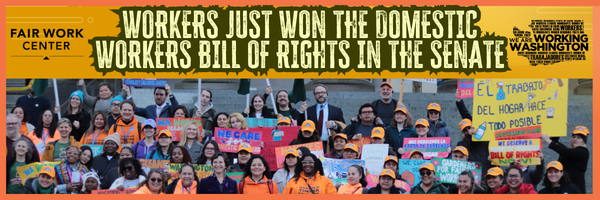
Fighting for Justice: A Domestic Worker’s Victory and Why We Need a Bill of Rights

In Washington state, thousands of domestic workers—nannies, house cleaners, and caregivers—work without the most basic labor protections. Many face wage theft, unfair working conditions, and employer exploitation. Seattle workers won the Seattle Domestic Workers Ordinance that establishes overdue protections for domestic workers in the city, but workers statewide still lack clear, enforceable rights—which is why we are fighting for a Washington Domestic Workers Bill of Rights.

Recently, our legal team at Working Washington and Fair Work Center represented a domestic worker in a case that highlights why these protections are so urgently needed.

This worker, referred to our legal team through Casa Latina, had recently immigrated from Honduras. She and her adolescent daughter were living in a women’s shelter while she tried to establish financial stability. Like many domestic workers, she faced unpredictable work schedules, no guaranteed wages, and no labor protections.

Throughout her employment, her employer denied her rest breaks—a violation of Seattle labor laws. When she needed to take legally protected sick time, her employer denied this. Additionally, the employer offered to loan her money for car repairs but charged exorbitant, undisclosed interest, trapping her in a cycle of debt. Ultimately, the instability of the job forced her to step away voluntarily.

When our legal team got involved, we helped the worker calculate her damages, which included:

  • Missed meal and rest breaks
  • Recovering the unfairly charged interest from the loan
  • Penalties for being denied protected sick time

She initially sought $9,500 in damages, but penalties for the employer’s violations pushed her case above the $10,000 cap for small claims court. After sending a demand letter, the employer hired a lawyer and attempted to intimidate her—a common tactic used against immigrant workers. But with legal support and persistence, she secured a $15,000 settlement, enough to move her family into stable housing.

The Bigger Picture: Why We Need a Domestic Workers Bill of Rights

This case is a hopeful story, but no worker should have to go through this just to claim their basic rights. Employers exploit the vulnerabilities of immigrant workers, using fear and misinformation to prevent them from speaking out. But the truth is that all workers—regardless of immigration status—have rights.

If the Washington Domestic Workers Bill of Rights were in place, this worker wouldn’t have had to fight for what she deserves, such as:

✅ Paid sick leave

✅ Overtime pay

✅ A guaranteed minimum wage

✅ The right to rest breaks

Domestic workers play a vital role in our economy and communities. It’s time we recognize their work and pass this bill to ensure they are treated with the dignity and fairness they deserve.

Take Action

Our fight isn’t over. Join us in pushing for a Domestic Workers Bill of Rights in Washington! Here’s how you can help:

📢 Share this story to raise awareness.

📞 Call your legislators and tell them to support worker protections by passing Senate bill 5023

Together, we can ensure no domestic worker is left unprotected.