
RESTAURANT WORKERS WIN A NEW TOOL TO GET WHAT WE’RE OWED


“My first time working in a restaurant you never got a break…One day, we had a new hire and she took a 30 like she was supposed to, and when she got back, she got yelled at by the managers because while, yes, we legally should get breaks, that ‘isn’t what we do here.’”

-Restaurant worker, in testimony at King County Board of Health

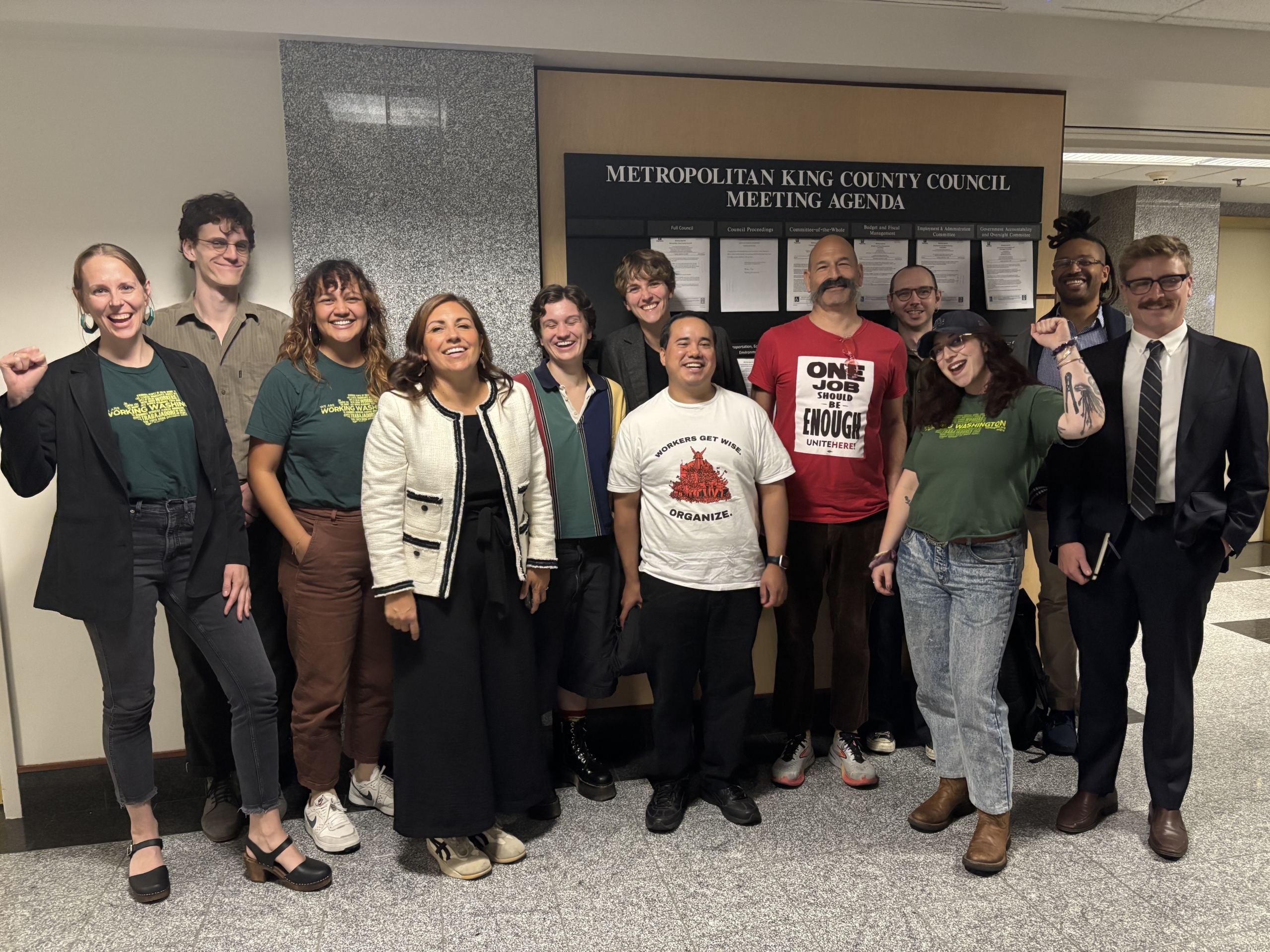
The vote is in and restaurant workers got a win! Starting next year the Board of Health can treat violations of workers’ rights as the public health issue they are. For too long, workers in food service have had to choose between a paycheck and our health. This puts workers and the customers we serve at risk. The King County Board of Health voted in our favor and now, through the county health department, we’ll have another tool to get what we’re owed. 

Too many of us can’t rely on our bosses respecting our rights at work and it is putting us and the public in danger. Some bosses intentionally make us work through breaks to the point of exhaustion. Others make us jump through hoops for those breaks or to take the paid sick leave we’ve earned. It is not just morally wrong and illegal. It is a dangerous public health problem. One Capitol Hill worker said it best in their testimony at the King County Board of Health:

“None of us really wants to work side by side with someone who is contagious with COVID or the flu. None of us wants to be served by someone who’s contagious or exhausted to the point of being unsafe. These workplace issues are intrinsically public health issues.”

With their expanded power, the county health department will be able to ensure not only that customers have safe places to eat and employers have safe businesses to run, but that restaurant workers have good, safe workplaces! If a restaurant has certain unpaid workers’ rights violations, health inspectors can go to the restaurant to conduct another health inspection. The health department can also place a second placard at the door, in addition to the health rating placard. The second placard will advise the public that the restaurant is under increased inspection because of unresolved workers’ rights violations. These are important tools that keep customers informed, more safe, and could be strong deterrents that prevent restaurants from violating our rights in the first place. They’re also just plain common sense. As King County Councilmember Teresa Mosqueda said, using a phrase a worker gave in testimony:

“Where there is smoke, there is often fire – if workers’ rights are being violated, we should at the very least make sure the food that is being served meets our public health food-safety standards and work to prevent the public’s health from being at risk.”

The newly expanded health code enforcement will also level the playing field for the small businesses that treat workers fairly and operate by the rules. Businesses that cheat their workers are undercutting fair businesses all to shave a few dollars off payroll. That’s just not right. These new health code enforcement powers will help remove the “race to the bottom” that unfair businesses are forcing onto the whole industry.

Food safety isn’t just about gloves and hairnets. It is also about workers being healthy and alert enough to work safely. Diners should be able to trust that the sandwich in front of them wasn’t made by someone pressured to work through a fever. Exhausted workers are more likely to make mistakes. This can lead to everything from knife wounds, food contamination, or even forgetting details on orders like allergies. The ability for the health department to make additional health inspections and advise the public that those increased inspections are due to unpaid labor violations increases public awareness and trust.

In conclusion: organized workers stay winning! And when workers win, everyone else does too.

For Immediate Release:
Sep. 12, 2025

Contact: Hannah Sabio-Howell | hannah@workingwa.org, (206) 573-2317

Adult Family Home workers seek to end unjust labor protection exclusions

Fair Work Center, on behalf of workers, to argue before Washington Supreme Court that exclusions from minimum wage rights for live-in care workers are unconstitutional

A Washington Supreme Court ruling in favor of workers could lead to a broader legislative action nullifying the live-in exemption and expanding coverage of fundamental labor standards to thousands of low-wage Washington workers

Olympia, WA – The Washington Supreme Court on Tuesday will hear oral arguments, presented by Fair Work Center Legal Director Jeremiah Miller, on the case of Bolina et al v. Assurecare, LLC asserting that the 64 year old exemption of live-in care workers from bedrock labor protections is unconstitutional.

The Case

Fair Work Center will be representing six workers formerly employed by several Adult Family Homes (AFHs) run by Assurecare. The workers – Ms. Bolina, Mr. Payag, Ms. Ocampo, Ms. Robles, Mr. Castillo and Mr. Villalobos – came to Fair Work Center in 2022 with horrific reports of workers’ rights abuses. The workers often worked shifts that were 24 hours long, without uninterrupted breaks or sleep, resulting in injuries and infections like COVID-19. The impact of these injuries and illnesses on these caregivers was compounded by their lack of access to sick leave. For this back-breaking labor, they were paid a flat daily rate regardless of how many hours they worked, amounting to as little as four dollars per hour with no overtime pay.

This experience for live-in care workers at AFHs is common. Though Washington is, in many ways, a national leader in protecting workers’ rights, the backbone of our state’s labor laws (the

Minimum Wage Requirement and Labor Standards Act, also known as the MWA) is fundamentally shaped by flawed federal laws. It contains unexplained exemptions to various labor protections for many categories of workers, including workers who live where they work.

The History

Accordingly, the MWA exempts “[a]ny individual whose duties require that [they] reside or sleep at the place of [their] employment…” from its protections. This exclusion derives from a shameful tradition in the United States denigrating the value of domestic work (including caregiving work), and the explicit exclusion of work that is performed by non-white, non-male identifying people from foundational labor laws.

The federal government in the 1930s enacted groundbreaking worker protections in the form of various “New Deal” laws, including the National Labor Relations Act, the Social Security Act, and the Fair Labor Standards Act. But these laws explicitly or implicitly excluded domestic workers and agricultural workers, part of a pattern of systematic and intentional exclusion of Black and female workers from all major New Deal legislation. As a tool for advancing overtly discriminatory interests, drafters used facially neutral categorical exclusions as proxies for excluding Black and female labor forces from the New Deal. The goal was simple: maintain the existing social hierarchy and prevent Black and female workers from gaining political power. Echoes of these decisions were codified in Washington law, with little or no discussion, in the 1960s.

The Impact

For live-in care workers today, these exemptions allow AFH employers to create work conditions that would be illegal for most workers, including other caregivers doing identical work, who do not live where they provide care. Wages on the order of a few dollars per hour, no breaks, and no access to state-protected sick leave are conditions that no worker should face. The very idea that “living-in” somehow makes a worker less deserving of protection cannot be separated from the social, cultural, and political contexts that have informed the way society devalues labor performed in the “domestic” sphere. It is time we shed the deeply racist and sexist thinking that never had any place in our country’s labor laws and certainly doesn’t today.

The Possible Outcome

Fair Work Center on Tuesday will seek a judgment from the Washington State Supreme Court that declares the live-in exemption to the MWA unconstitutional. If successful, this decision would follow on the heels of a 2020 decision (Martinez-Cuevas et al. v. DeRuyter Bros. Dairy Inc.) in which the Washington Supreme Court determined that excluding workers in dangerous jobs from the MWA violates the Washington Constitution’s unique Privileges and Immunities Clause. As a result, the Washington state Legislature ended the overtime exemption for all agricultural employees. Fair Work Center’s case could similarly extend these constitutional protections to live-in caregivers, who are overdue for access to minimum labor standards.

Comments from plaintiffs and legal experts are included below. Contact Hannah Sabio-Howell to arrange an interview.


“Justice is slow, but I’m glad we made it to this point. I hope the Court listens to the experiences of workers in this job. This job isn’t easy, and you don’t get compensated much. You’re there 24/7, taking care of up to six people at the same time that all have different needs, exposed to diseases or possible back injuries every day, with no health benefits or the right to a 401k. I hope we come away with laws that protect us and that other Adult Family Care workers learn we deserve more.” – Hollee Christian Castillo, plaintiff


“The courage of the six workers I have the honor of representing is emblematic of the tenacity and commitment of this entire industry of workers. Adult Family Home workers care for elders and disabled loved ones day in and day out, and, since the creation of Adult Family Homes in the late 1980s, have worked in one of the few industries exempted from the right to fair pay and safe workplaces. It’s time for this shameful legacy in our labor laws to end in Washington state.” – Jeremiah Miller, Legal Director